Minnesota grade 2 math worksheets
Every Minnesota grade 2 math standard by its own code, with the printable sheets that practise it: 20 of 20 have sheets. New problems every time, answer keys and a one-page guide for grown-ups. Free, no sign-up.
Number & operations
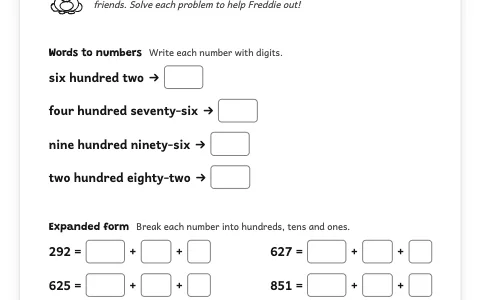
- 2.1.1.1Read, write and represent whole numbers up to 1000.Reading and writing numbers
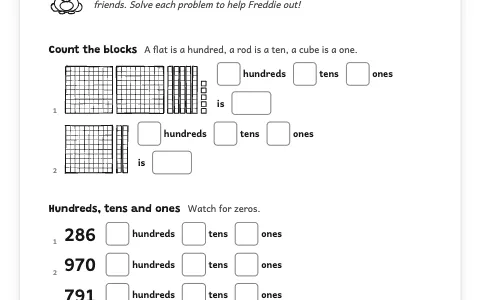
- 2.1.1.2Describe numbers up to 1000 as hundreds, tens and ones.Hundreds, tens and ones
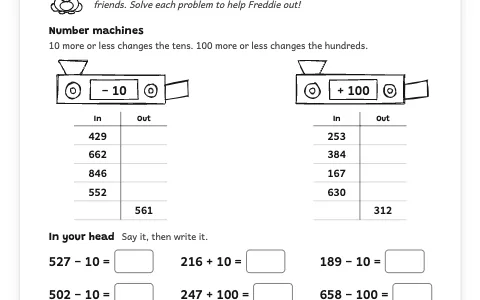
- 2.1.1.3Find 10 or 100 more or less than a three-digit number.Adding and subtracting 10 or 100
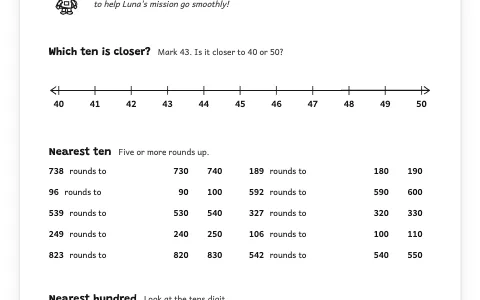
- 2.1.1.4Round numbers up or down to the nearest 10 and 100.Rounding to 10 and 100 (Grade 3)
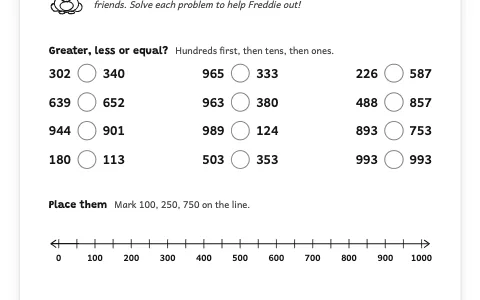
- 2.1.1.5Compare and order whole numbers up to 1000.Comparing three-digit numbers
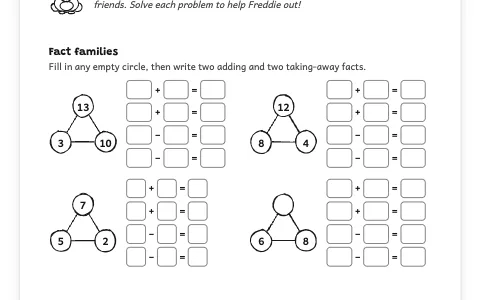
- 2.1.2.1Use strategies like doubles, making ten and fact families to find addition and subtraction facts.Fact families (Grade 1) · Turn-around and grouping facts (Grade 1) · Facts within 20
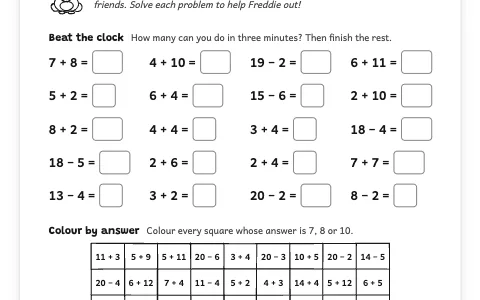
- 2.1.2.2Know basic addition facts and related subtraction facts fluently.Facts within 20
- 2.1.2.3Estimate sums and differences up to 100.Estimating sums and differences (Grade 3) · Two-step story problems (Grade 3)
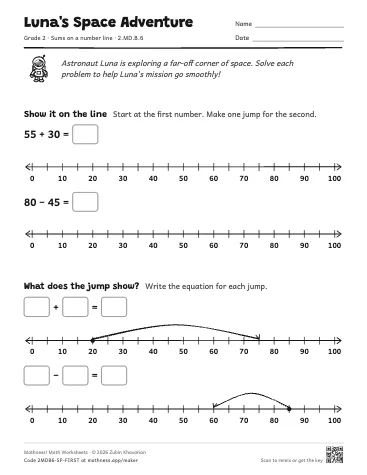
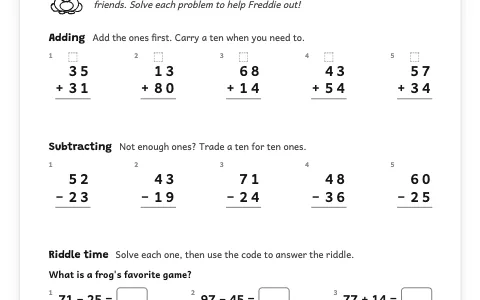
- 2.1.2.4Add and subtract two-digit numbers with place-value strategies such as partial sums.Adding and subtracting within 100 · Checking strategies
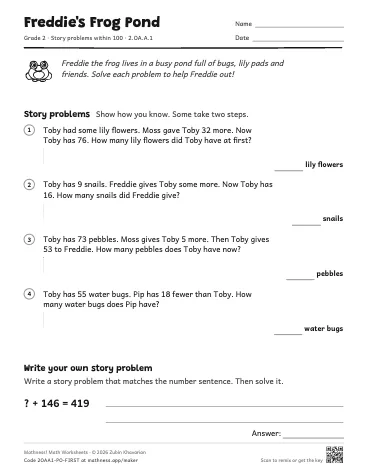
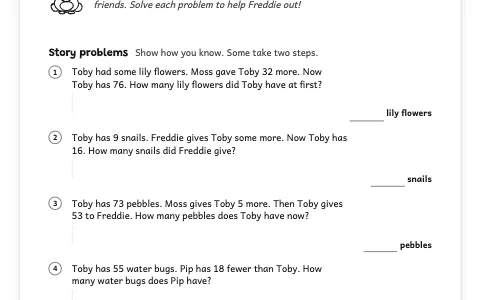
- 2.1.2.5Solve word problems adding and subtracting numbers with up to two digits.Story problems within 100
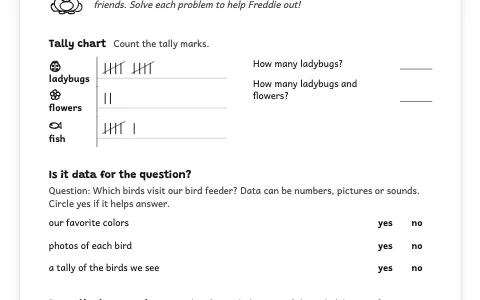
- 2.1.2.6Use adding and subtracting to make and read tables, bar graphs and tally charts.Picture and bar graphs

Algebraic reasoning
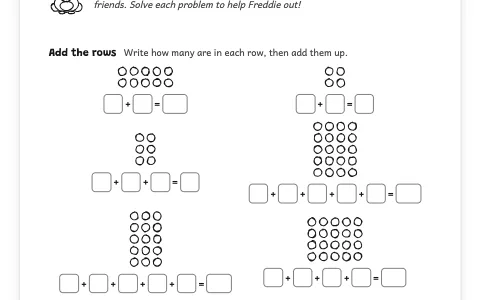
- 2.2.1.1Find and describe number patterns from repeated adding, skip counting and arrays.Arrays and repeated addition · Skip counting
- 2.2.2.1Interpret addition and subtraction number sentences where a letter stands for the unknown.Story problems within 100
- 2.2.2.2Write number sentences with unknowns for situations and find values that make them true.Story problems within 100
Geometry & measurement
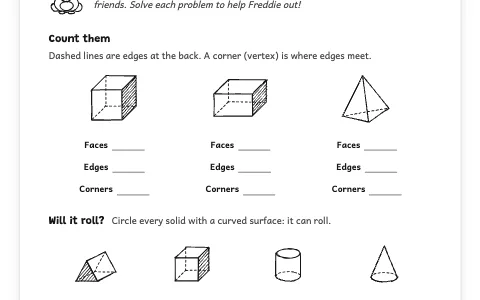
- 2.3.1.1Sort and compare shapes by counting faces, sides, edges and corners.Faces, edges and corners · Angles and faces
- 2.3.1.2Name basic flat and solid shapes such as hexagons, trapezoids, prisms and cones.Faces, edges and corners · Angles and faces
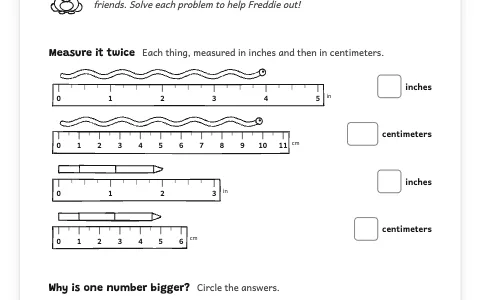
- 2.3.2.1See that smaller units mean more units are needed to measure the same length.Measuring in two units
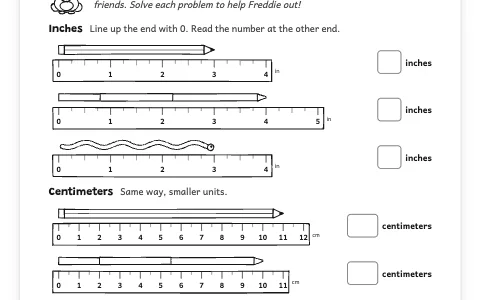
- 2.3.2.2Use a ruler to measure length to the nearest inch or centimeter.Measuring with a ruler
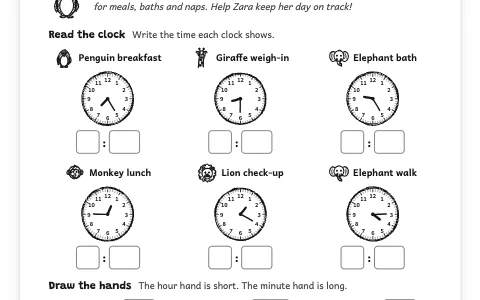
- 2.3.3.1Tell time to the quarter hour and tell a.m. from p.m.Time to 5 minutes
- 2.3.3.2Name coins including quarters, total their value and find coin combinations for an amount.Counting money
Summaries are ours, in plain words. The same sheets by Common Core: Grade 2.