Missouri grade 3 math worksheets
Every Missouri grade 3 math standard by its own code, with the printable sheets that practise it: 42 of 42 have sheets. New problems every time, answer keys and a one-page guide for grown-ups. Free, no sign-up.
Place value
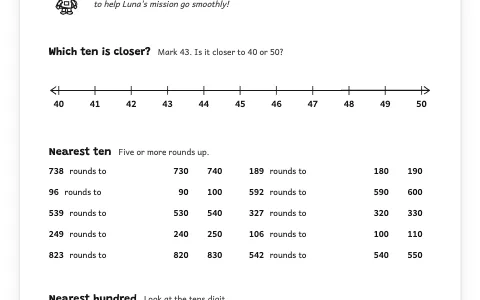
- 3.NBT.A.1Round whole numbers to the closest ten or hundred.Rounding to 10 and 100
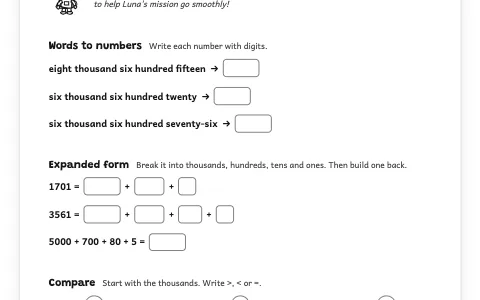
- 3.NBT.A.2Read and write whole numbers to 100,000 in digits, words and expanded form.Numbers to 10,000
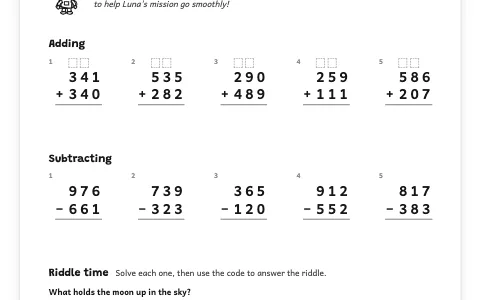
- 3.NBT.A.3Add and subtract within 1,000 fluently.Adding and subtracting within 1000
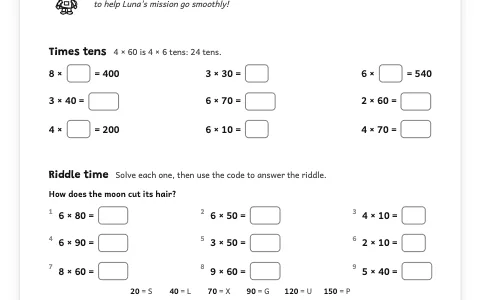
- 3.NBT.A.4Multiply one-digit numbers by multiples of 10 from 10 to 90.Multiplying by tens
Fractions
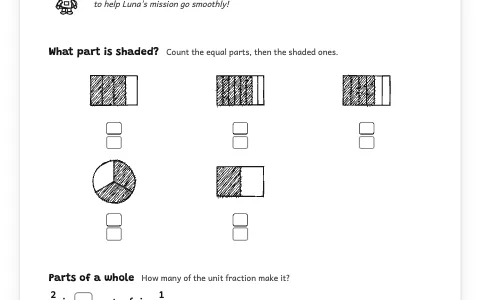
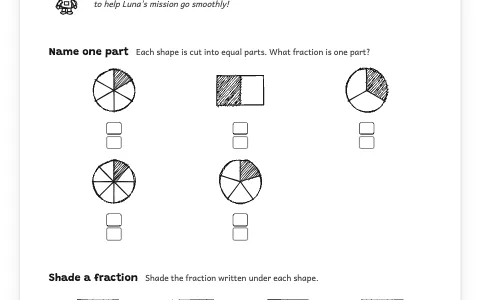
- 3.NF.A.1Understand a unit fraction as one of the equal parts of a whole.Fractions of a whole
- 3.NF.A.2Use a fraction for part of an equally split whole; explain numerator and denominator.Fractions of a whole
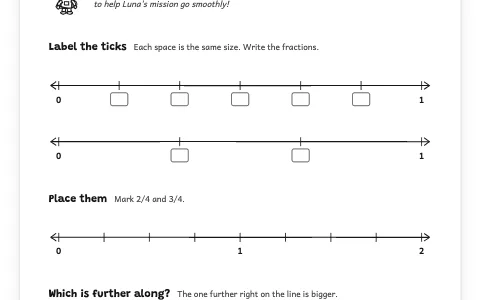
- 3.NF.A.3Place fractions on a number line, treating 0 to 1 as the whole split into equal parts.Fractions on a number line
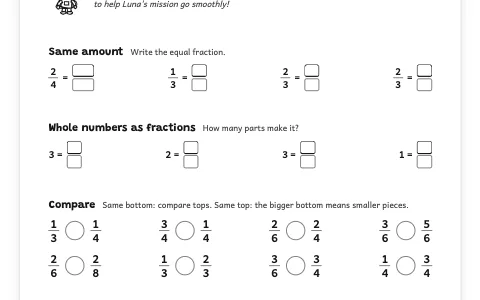
- 3.NF.A.4Explain that equivalent fractions name equal amounts or land on one spot on a number line.Equivalent and comparing fractions
- 3.NF.A.5Recognize and make equivalent fractions with models and explain why they are equal.Equivalent and comparing fractions
- 3.NF.A.6Compare fractions with the same numerator or denominator using >, = or <, and justify.Equivalent and comparing fractions
- 3.NF.A.7Explain why fractions can only be compared when they refer to the same whole.Equivalent and comparing fractions
Relationships & algebraic thinking
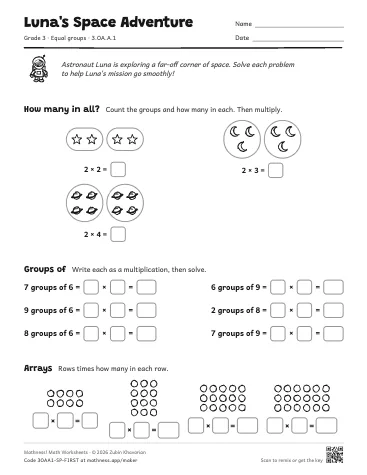
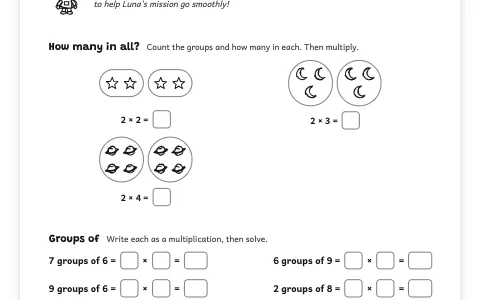
- 3.RA.A.1Interpret a product as a number of equal groups.Equal groups
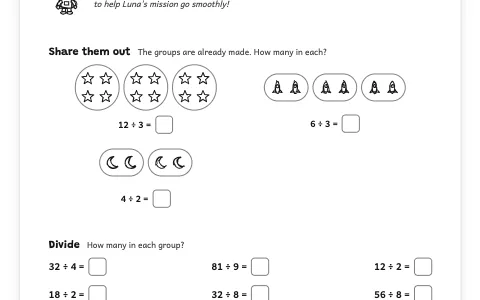
- 3.RA.A.2Interpret a quotient as equal sharing or as a number of equal groups.Sharing equally
- 3.RA.A.3Describe a story or drawing that shows a multiplication or division situation.Equal groups · Sharing equally
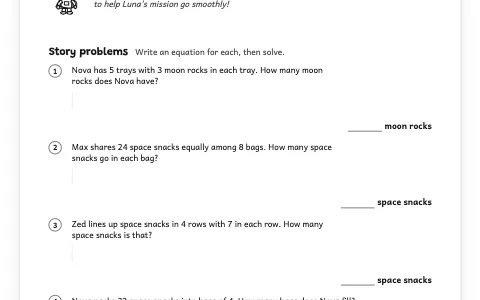
- 3.RA.A.4Solve multiplication and division problems within 100.Multiplication and division stories
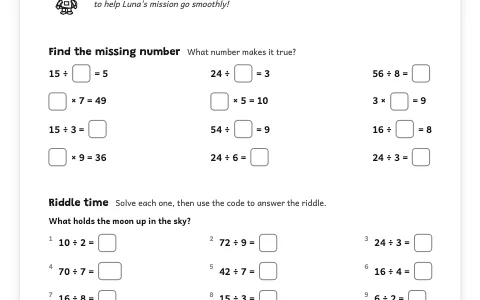
- 3.RA.A.5Find the missing number in a multiplication or division equation with three numbers.Missing factors
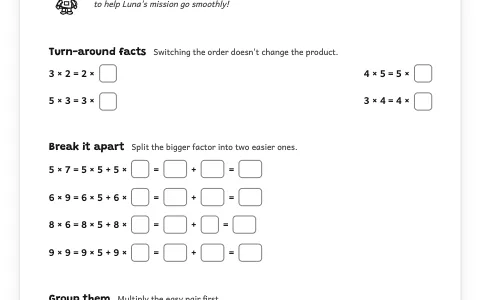
- 3.RA.B.6Use properties of operations as strategies for multiplying and dividing.Multiplying with properties · Division as a missing factor
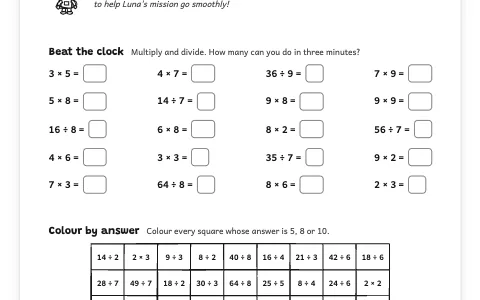
- 3.RA.C.7Multiply and divide within 100 with strategies, and know all one-digit products.Times tables
- 3.RA.C.8Multiply with products up to 100 fluently.Times tables
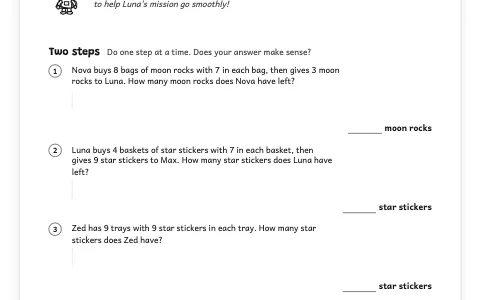
- 3.RA.D.9Write and solve two-step problems with an unknown using any of the four operations.Two-step story problems
- 3.RA.D.10Check whether answers make sense using mental math, estimation and rounding.Two-step story problems
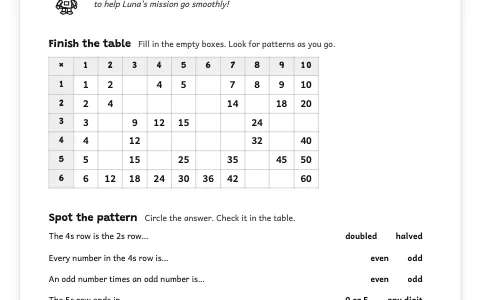
- 3.RA.E.11Find patterns in arithmetic and explain them with properties of operations.Patterns in tables
Geometry & measurement
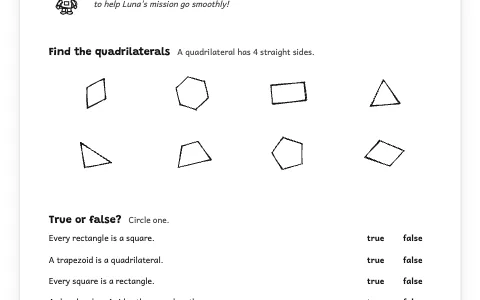
- 3.GM.A.1Know that shapes in different groups can share features that define a larger group.Quadrilaterals
- 3.GM.A.2Recognize rhombuses and rectangles as quadrilaterals and draw quadrilaterals that are neither.Quadrilaterals
- 3.GM.A.3Split shapes into parts with equal area and name each part as a unit fraction.Equal parts as fractions
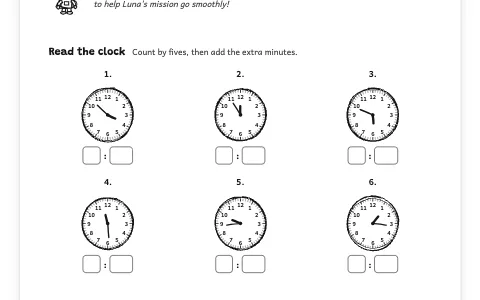
- 3.GM.B.4Read clocks and write times to the exact minute.Time to the minute
- 3.GM.B.5Estimate lengths of time in minutes.Time to the minute
- 3.GM.B.6Solve problems that add or subtract minutes.Time to the minute
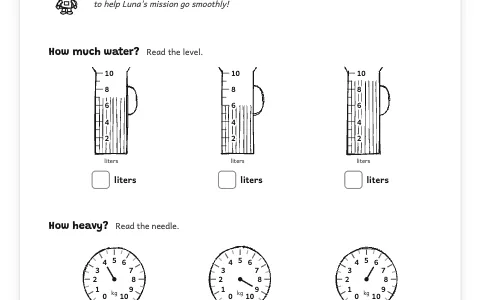
- 3.GM.B.7Measure or estimate the length, liquid volume and weight of objects.Liters and kilograms
- 3.GM.B.8Solve problems with any operation on lengths, liquid volumes or weights in the same units.Liters and kilograms
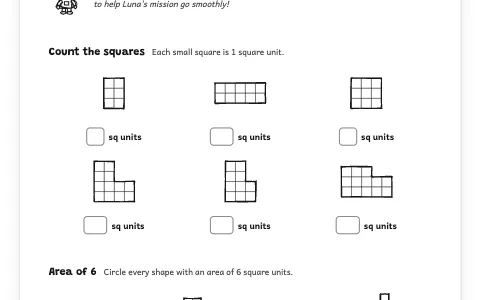
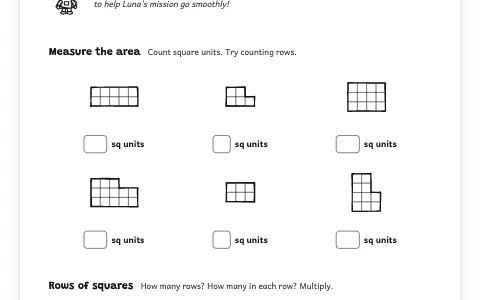
- 3.GM.C.9Find area by covering a flat shape with unit squares, leaving no gaps or overlaps.What is area? · Measuring area
- 3.GM.C.10Write area measurements in square units.Measuring area
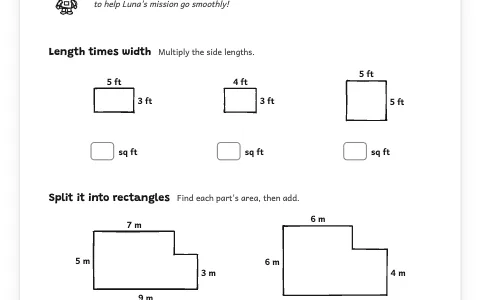
- 3.GM.C.11Show that tiling a rectangle and multiplying its sides give the same area.Area by multiplying
- 3.GM.C.12Multiply whole-number side lengths to solve rectangle area problems.Area by multiplying
- 3.GM.C.13Find the different rectangles that can be made with a given area.Area by multiplying
- 3.GM.C.14Split a rectangle into smaller rectangles and add their areas to find the whole area.Area by multiplying
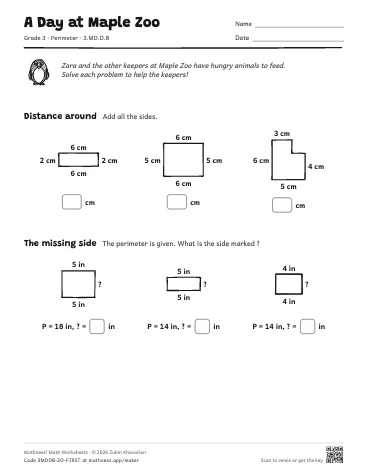
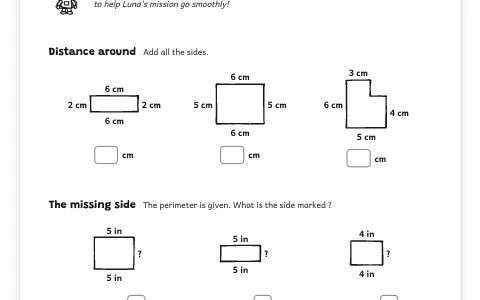
- 3.GM.D.15Solve problems about the perimeter of polygons.Perimeter
- 3.GM.D.16Understand rectangles can share a perimeter but differ in area, or share an area but differ in perimeter.Perimeter
Data & statistics
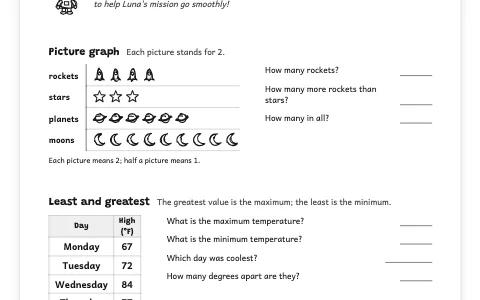
- 3.DS.A.1Make frequency tables and scaled picture and bar graphs for data with several categories.Scaled graphs
- 3.DS.A.2Solve one- and two-step problems using bar graphs or picture graphs.Scaled graphs
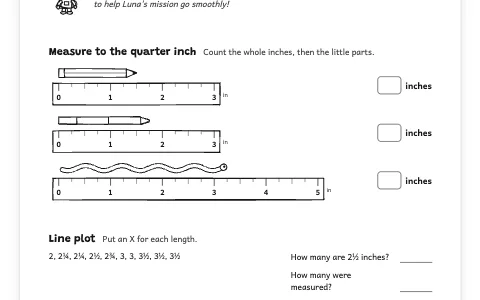
- 3.DS.A.3Make a line plot to show a set of data.Measuring to ¼ inch
- 3.DS.A.4Answer questions using data shown on a line plot.Measuring to ¼ inch
Summaries are ours, in plain words. The same sheets by Common Core: Grade 3.