Minnesota (2027–28) grade 5 math worksheets
Every Minnesota 2027–28 grade 5 math standard by its own code, with the printable sheets that practise it: 40 of 40 have sheets. New problems every time, answer keys and a one-page guide for grown-ups. Free, no sign-up.
Data & probability
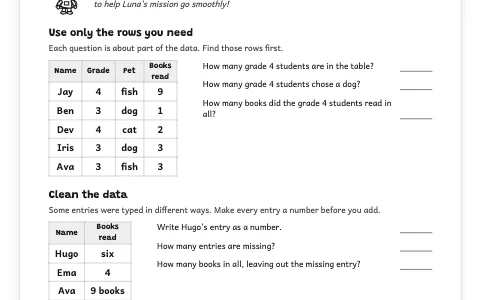
- 5.1.1.1Notice patterns in related data sets and ask meaningful statistical questions.Choosing and cleaning data (Grade 4) · Line plots and sharing
- 5.1.1.2Compare and contrast categorical and numerical data.Choosing and cleaning data (Grade 4)
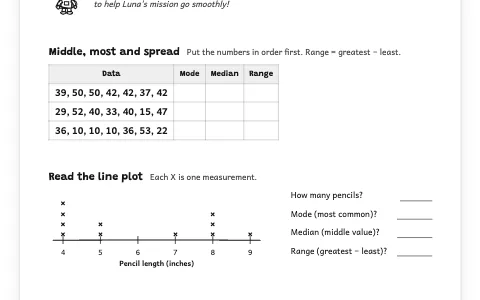
- 5.1.1.3Collect data and analyze mean, median and range.Mode, median and range (Grade 4) · Mean, median, mode and range
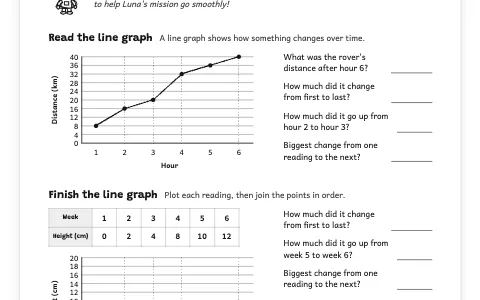
- 5.1.1.4Analyze bar graphs, line graphs and line plots with center and spread to support claims.Line graphs (Grade 4) · Mean, median, mode and range · Line plots and sharing
- 5.1.1.5Compare data displays and how each affects what we conclude.Solving problems with data
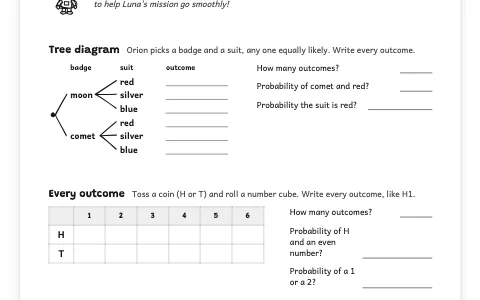
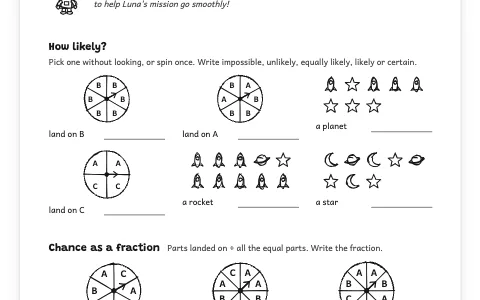
- 5.1.2.1Record outcomes of a probability experiment in a frequency table.Outcomes and probability
- 5.1.2.2Use experiment results to predict and place predictions on a 0-to-1 number line.Chance and probability (Grade 4) · Outcomes and probability

Spatial reasoning
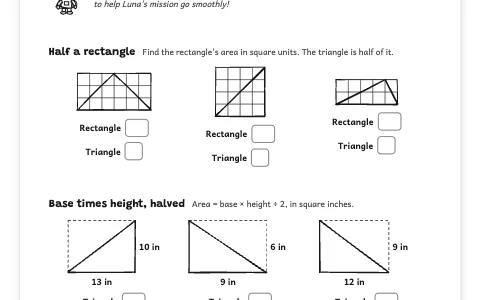
- 5.2.3.1Develop and use area formulas for parallelograms and triangles.Area of triangles (Grade 4)
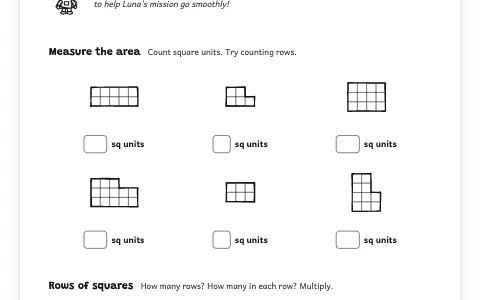
- 5.2.3.2Estimate areas of polygons and curved shapes using dot or grid paper.Measuring area (Grade 3)
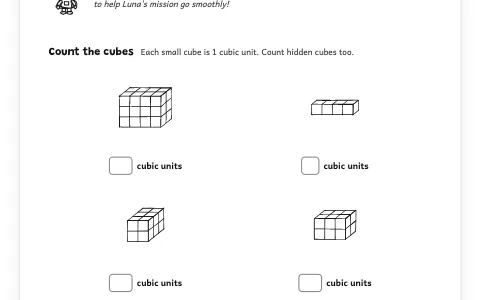
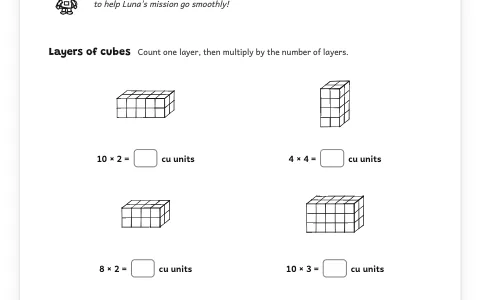
- 5.2.3.3Use unit cubes, each one cubic unit, to measure volume.What is volume?
- 5.2.3.4Find volume and surface area of solids built from unit cubes.Measuring volume
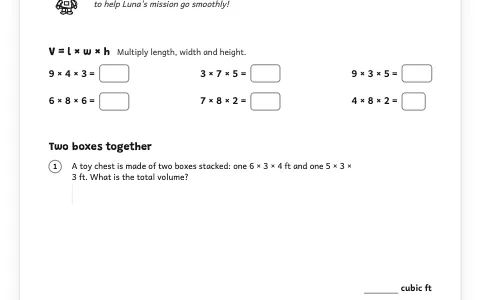
- 5.2.3.5Find volume of rectangular prisms by packing cubes or multiplying edge lengths or base times height.Volume formulas
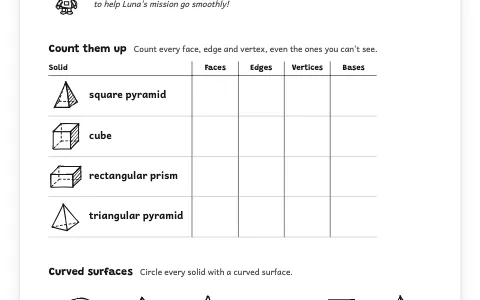
- 5.2.4.1Classify prisms and pyramids by edges, faces, vertices and bases.Faces, edges and vertices
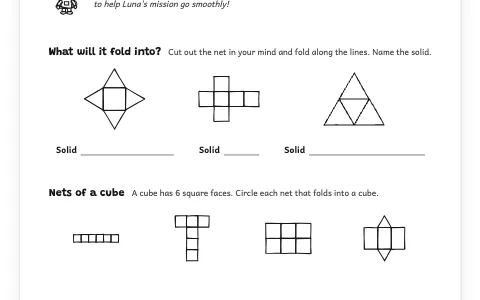
- 5.2.4.2Recognize, draw and compare nets for prisms, pyramids, cylinders and cones.Nets of solids
Patterns & relationships
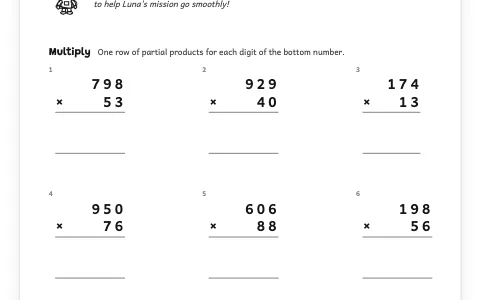
- 5.3.5.1Multiply multi-digit numbers efficiently and justify with properties and place value.Multi-digit multiplication
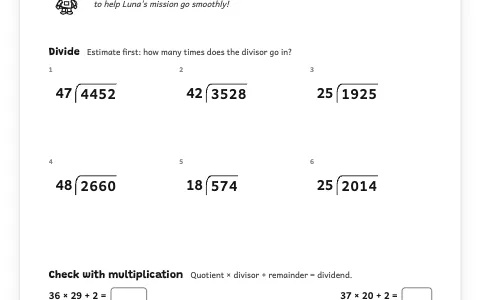
- 5.3.5.2Divide by one- or two-digit divisors; write quotients as remainders, fractions or decimals.Dividing by two digits · Fractions as division
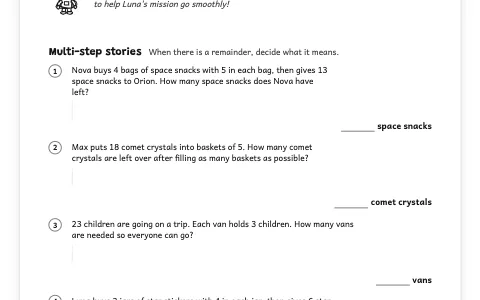
- 5.3.5.3Use the context of a division problem to choose the best form of quotient and remainder.Multi-step problems (Grade 4) · Fractions as division
- 5.3.5.4Solve multi-step problems using all four operations with multi-digit whole numbers.Multi-step problems (Grade 4) · Multi-digit multiplication · Dividing by two digits
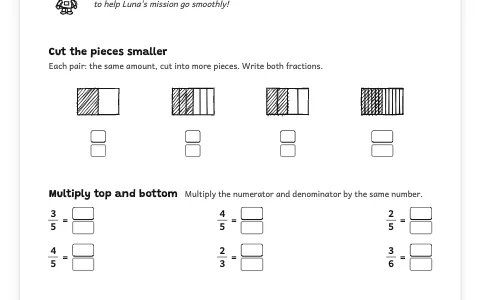
- 5.3.5.5Make equivalent fractions by multiplying or dividing top and bottom by the same number.Equivalent fractions (Grade 4)
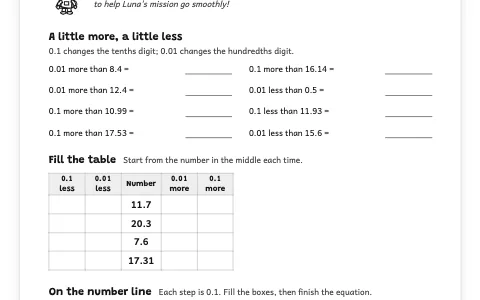
- 5.3.5.6Mentally find 0.1, 0.01 or 0.001 more or less than a number and explain.0.1 and 0.01 more or less (Grade 4)
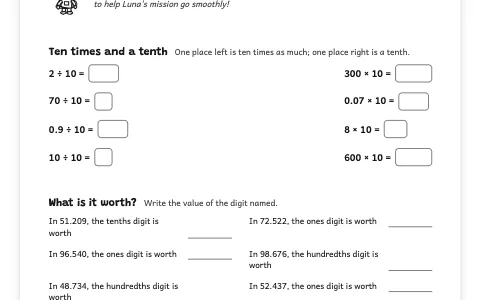
- 5.3.5.7A digit is worth ten times its value one place right, one tenth its value one place left.Place value with decimals
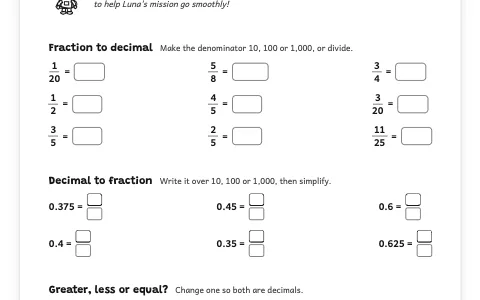
- 5.3.5.8Switch between fractions and decimals to thousandths and justify with models.Fractions and decimals together · Decimals to hundredths (Grade 4) · Decimals to thousandths
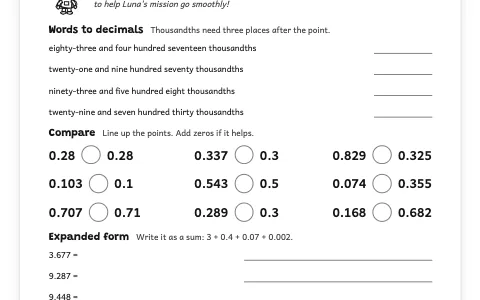
- 5.3.5.9Compare and order decimals to thousandths and justify with place value.Decimals to thousandths
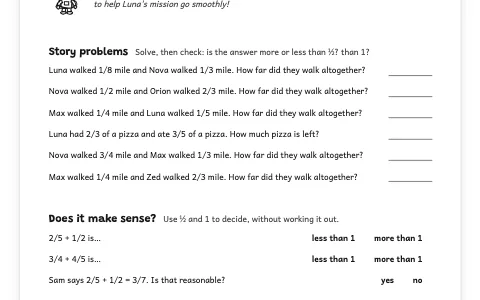
- 5.3.5.10Estimate sums and differences of fractions and mixed numbers to the nearest half.Fraction story problems
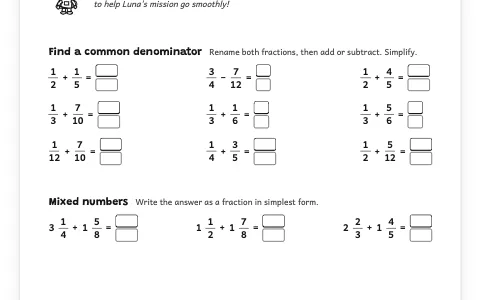
- 5.3.5.11Add and subtract fractions and mixed numbers with unlike denominators fluently.Unlike denominators
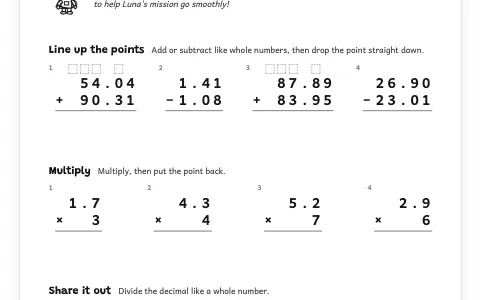
- 5.3.5.12Estimate sums and differences of decimals.Decimal operations
- 5.3.5.13Solve story problems adding and subtracting fractions, mixed numbers or decimals.Decimal operations · Fraction story problems
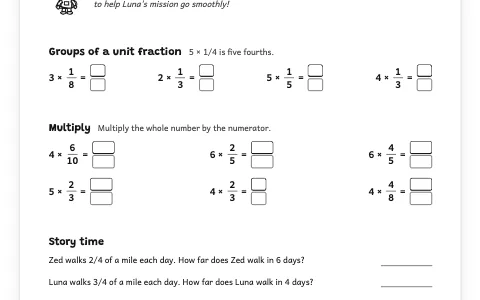
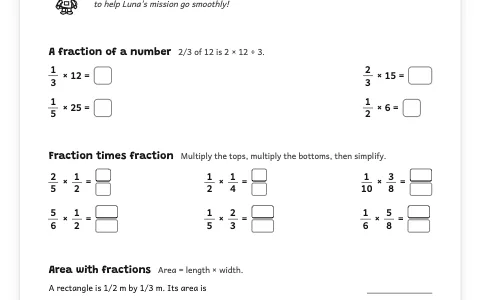
- 5.3.5.14Model a whole number times a fraction with pictures or a number line.Fraction times a whole number (Grade 4)
- 5.3.5.15Model a fraction of a whole-number group with pictures or a number line.Multiplying fractions
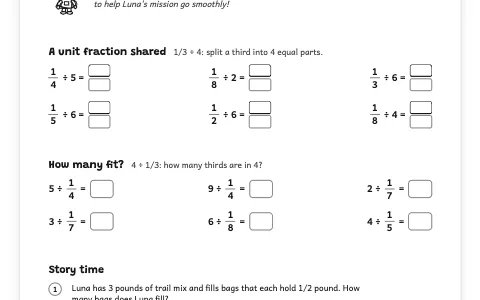
- 5.3.5.16Model how many fractional-size groups fit in a whole number (n divided by a/b).Dividing with unit fractions
- 5.3.5.17Solve multi-step problems adding and subtracting fractions and decimals; check reasonableness.Decimal operations · Fraction story problems
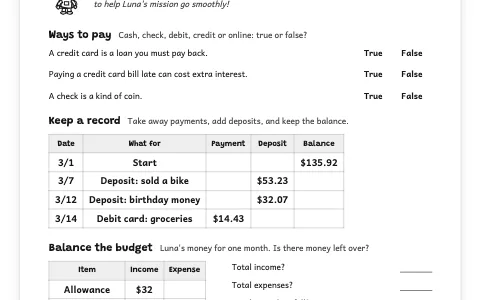
- 5.3.5.18Compare ways to pay and get paid, such as checks, cards and electronic payments.Ways to pay
- 5.3.5.19Use the four operations to build a budget and explore debt and its effects.Budgets and records
- 5.3.6.1Use relational thinking to find missing values in fraction and decimal sentences.True or false equations
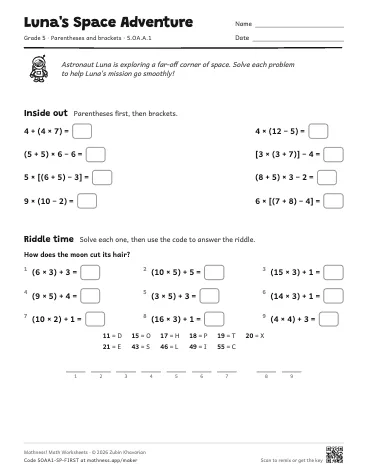
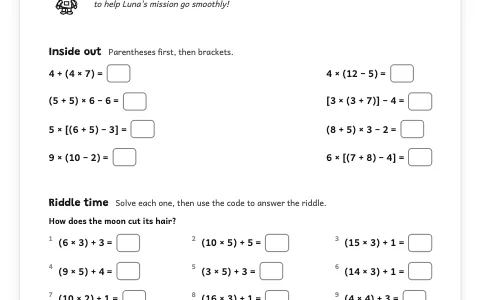
- 5.3.6.2Make and justify claims about expressions with parentheses using properties of operations.Parentheses and brackets · Writing expressions
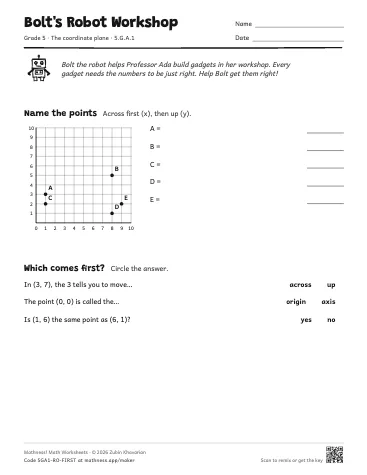
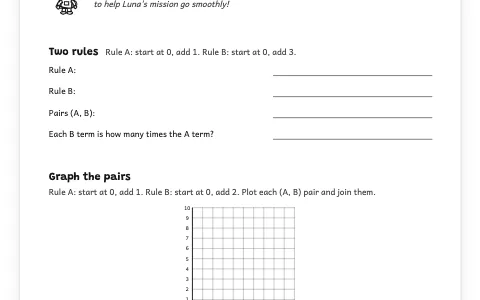
- 5.3.7.1Make ordered pairs from a rule or table and graph them on a coordinate grid.Two patterns · The coordinate plane · Plotting points
- 5.3.7.2Find and explain relationships between two patterns made from given rules.Two patterns
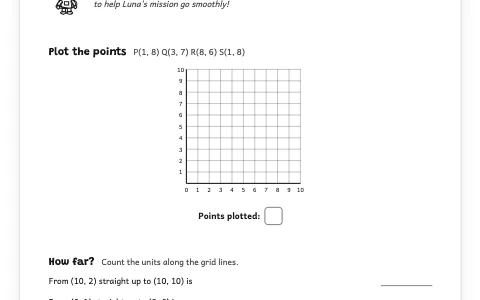
- 5.3.7.3Graph whole and half-unit points in the first quadrant and interpret them in context.Plotting points
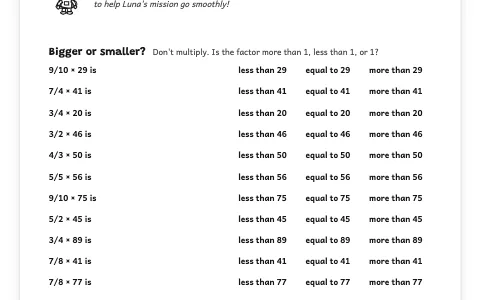
- 5.3.7.4Use ratio tables to solve problems and see multiplication as scaling.Multiplying as scaling
- 5.3.7.5Write a rule linking figure number to item count in a picture pattern and find figure n.Input-output tables (Grade 4) · Number patterns (Grade 4)



Summaries are ours, in plain words. The same sheets by Common Core: Grade 5.