Minnesota grade 3 math worksheets
Every Minnesota grade 3 math standard by its own code, with the printable sheets that practise it: 26 of 26 have sheets. New problems every time, answer keys and a one-page guide for grown-ups. Free, no sign-up.
Number & operations
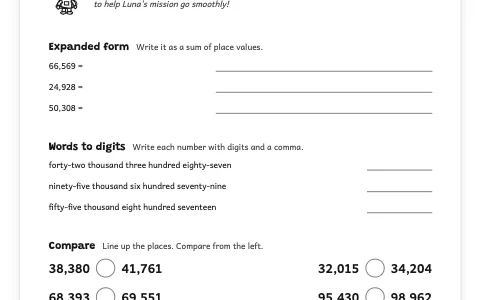
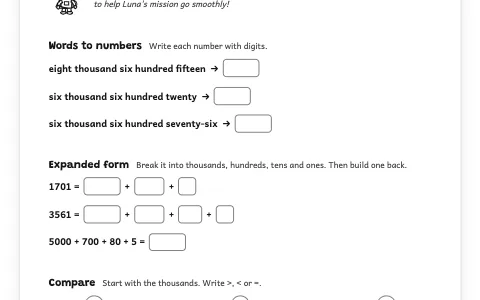
- 3.1.1.1Read, write and represent whole numbers up to 100,000.Numbers to 100,000 · Reading big numbers (Grade 4)
- 3.1.1.2Describe numbers up to 100,000 by place value from ten thousands to ones.Numbers to 100,000 · Ten times the place (Grade 4)
- 3.1.1.3Find 100, 1000 or 10,000 more or less than four- and five-digit numbers.Numbers to 10,000 · Adding and subtracting 10 or 100 (Grade 2) · Multiplying with properties
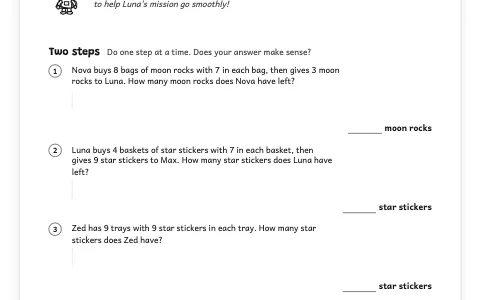
- 3.1.1.4Round to the nearest 10, 100, 1000 or 10,000 and use rounding to estimate.Two-step story problems · Rounding to 10 and 100 · Rounding big numbers (Grade 4)
- 3.1.1.5Compare and order whole numbers up to 100,000.Numbers to 100,000 · Reading big numbers (Grade 4)
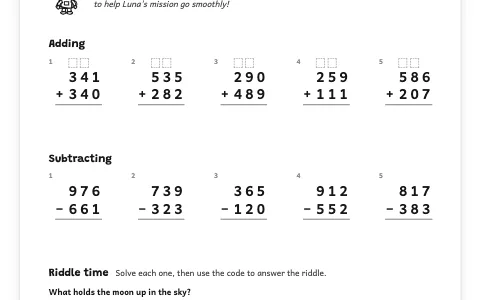
- 3.1.2.1Add and subtract multi-digit numbers with place-value methods including the standard algorithm.Adding and subtracting within 1000 · Adding and subtracting big numbers (Grade 4)
- 3.1.2.2Solve addition and subtraction problems and check whether answers make sense.Two-step story problems
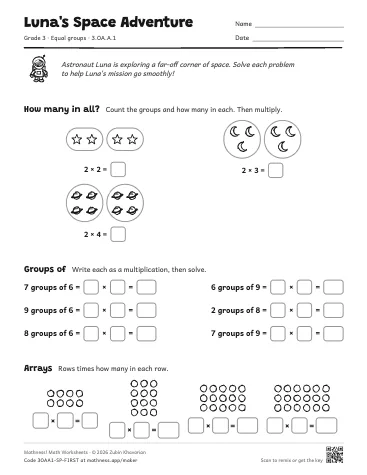
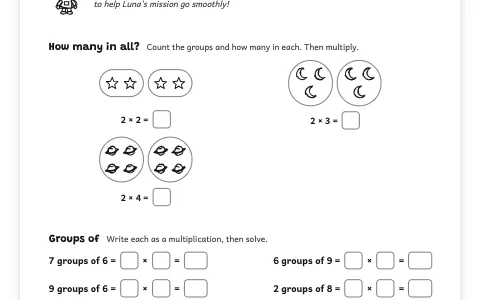
- 3.1.2.3Show multiplication and division facts with groups, arrays and number lines; relate the two operations.Equal groups · Sharing equally · Division as a missing factor
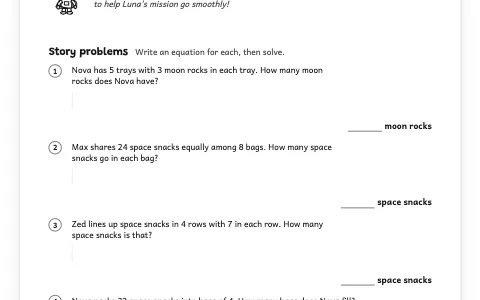
- 3.1.2.4Solve multiplication and division word problems, including both kinds of division situations.Multiplication and division stories
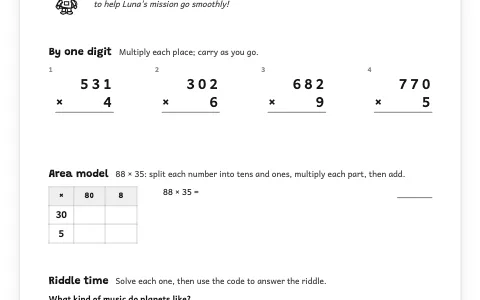
- 3.1.2.5Multiply a two- or three-digit number by a one-digit number using place-value strategies.Multiplying bigger numbers (Grade 4)
- 3.1.3.1Read and write fractions as parts of a whole, parts of a set or number-line points.Fractions of a set · Fractions of a whole · Fractions on a number line
- 3.1.3.2Understand a fraction's size depends on the size of its whole.Equivalent and comparing fractions
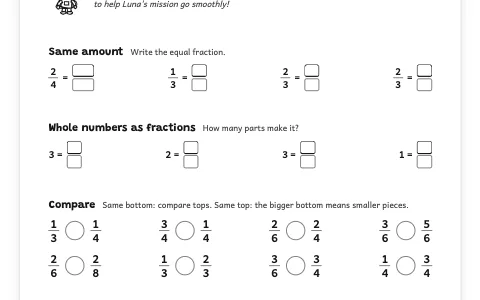
- 3.1.3.3Compare and order unit fractions and fractions with the same denominator using models.Equivalent and comparing fractions

Algebraic reasoning
- 3.2.1.1Make and use one-step input-output rules with adding, subtracting or multiplying.Input-output tables (Grade 4) · Patterns in tables
- 3.2.2.1Interpret multiplication and division number sentences with unknowns and make up matching stories.Equal groups · Sharing equally · Missing factors
- 3.2.2.2Write multiplication or division number sentences for problems and find the unknown values.Multiplication and division stories · Missing factors

Geometry & measurement
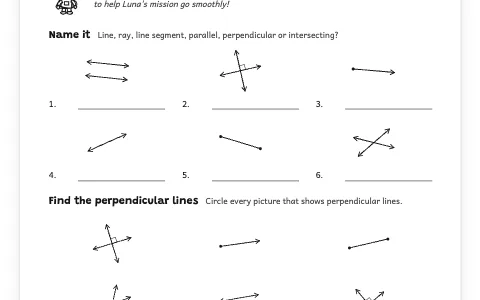
- 3.3.1.1Identify parallel and perpendicular lines and use them to describe and draw shapes.Lines, rays and segments (Grade 4) · Classifying shapes (Grade 4)
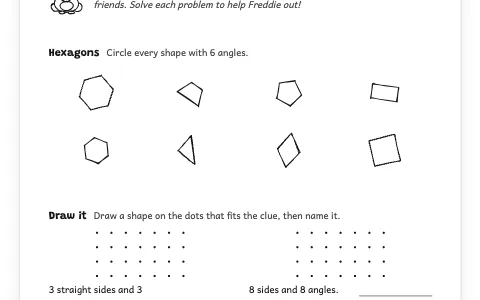
- 3.3.1.2Sketch polygons with a given number of sides or corners.Angles and faces (Grade 2)
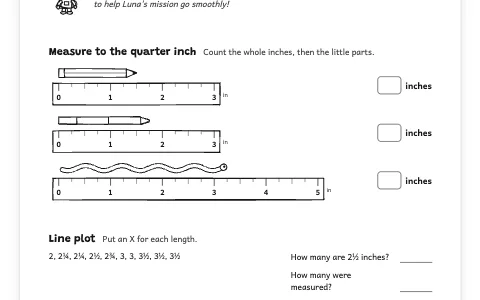
- 3.3.2.1Measure distances using half units.Measuring to ¼ inch
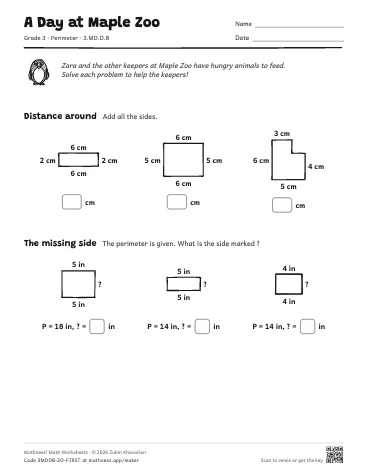
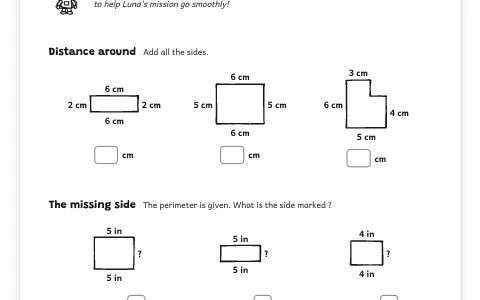
- 3.3.2.2Find a polygon's perimeter by adding its side lengths.Perimeter
- 3.3.2.3Measure the distance around real objects.Perimeter
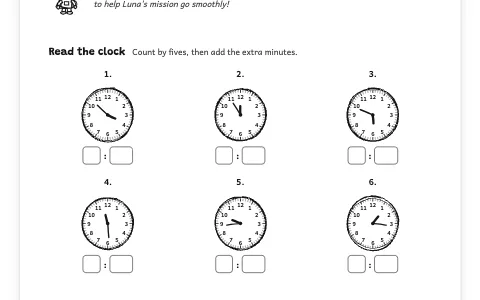
- 3.3.3.1Tell time to the minute on digital and analog clocks and find elapsed time.Time to the minute
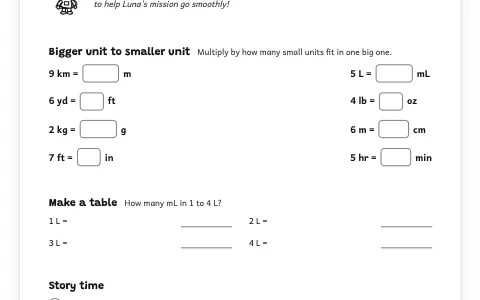
- 3.3.3.2Know how units of time relate, such as minutes in an hour.Converting units (Grade 4)
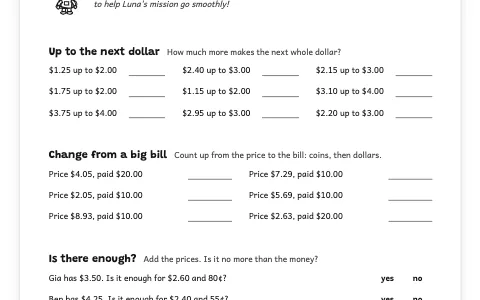
- 3.3.3.3Make change up to one dollar in different ways, including the fewest coins.Making change to $5 · Counting money (Grade 2)
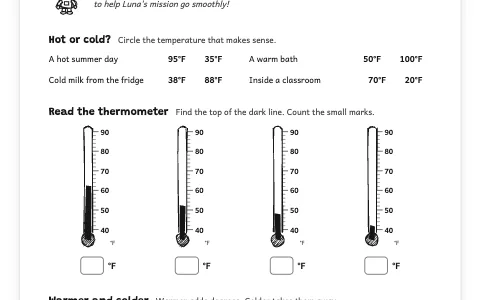
- 3.3.3.4Read an analog thermometer to the nearest degree in Fahrenheit and Celsius.Reading temperature
Data analysis
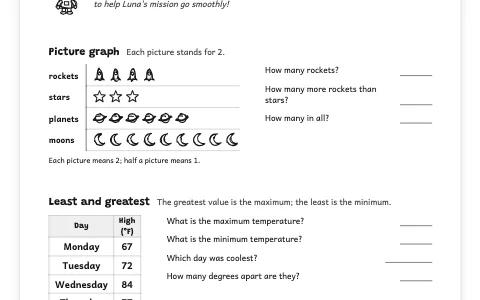
- 3.4.1.1Collect data and show it in tables, bar graphs, picture graphs and line plots with scales.Scaled graphs · Measuring to ¼ inch
Summaries are ours, in plain words. The same sheets by Common Core: Grade 3.