South Dakota (2027–28) grade 3 math worksheets
Every South Dakota 2027–28 grade 3 math standard by its own code, with the printable sheets that practise it: 50 of 50 have sheets. New problems every time, answer keys and a one-page guide for grown-ups. Free, no sign-up.
Numbers & operations
- 3.N.1Round whole numbers to the nearest 10 or 100.Rounding to 10 and 100
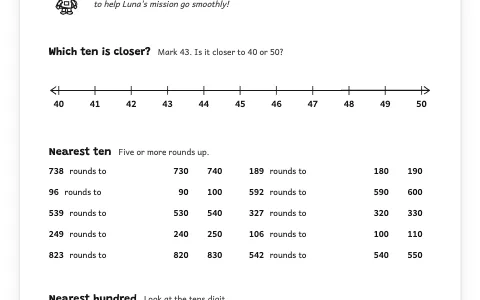
- 3.N.2Break four-digit numbers into thousands, hundreds, tens, and ones.Numbers to 10,000
- 3.N.3Read and write numbers to 10,000 in standard, word, and expanded form.Numbers to 10,000
Operations & algebraic thinking
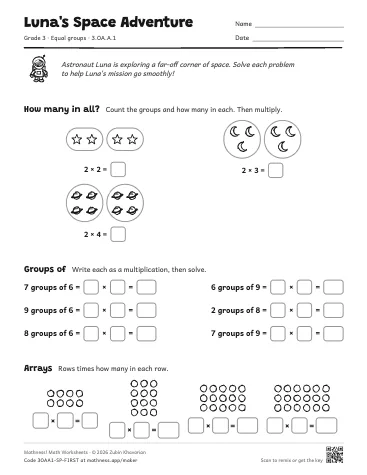
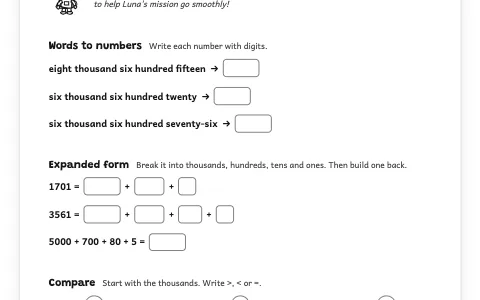
- 3.OA.1Use arrays, equal groups, and number lines to explain multiplication.Equal groups
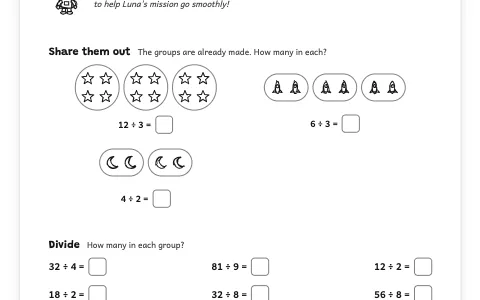
- 3.OA.2Use arrays, equal groups, and number lines to explain division as equal sharing.Sharing equally
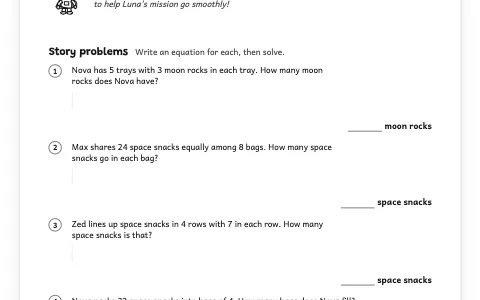
- 3.OA.3Solve multiply and divide story problems within 100 with drawings and equations.Multiplication and division stories
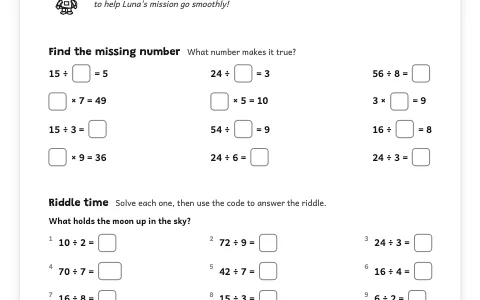
- 3.OA.4Find the missing number in a multiplication or division equation.Missing factors
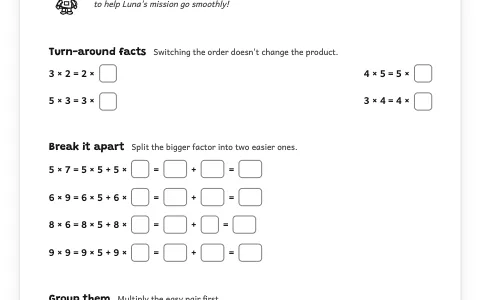
- 3.OA.5Use properties of operations to multiply and divide.Multiplying with properties
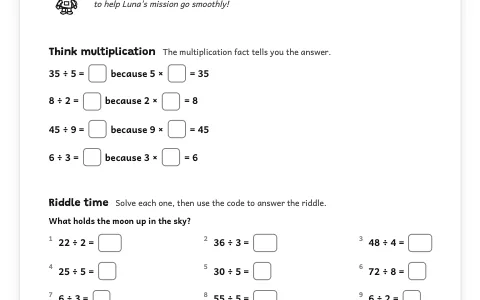
- 3.OA.6Know that multiplication and division undo each other.Division as a missing factor
- 3.OA.7Use arrays, groups, and number lines to relate multiplying and dividing within 100.Times tables
- 3.OA.8Use order, grouping, and identity properties for both adding and multiplying.Multiplying with properties
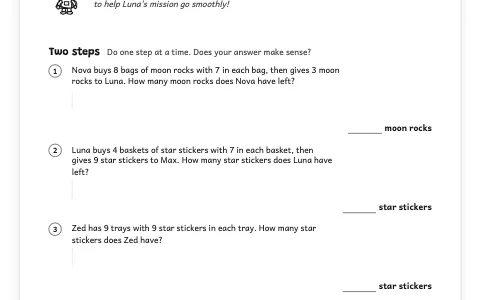
- 3.OA.9Solve two-step story problems with all four operations and check by estimating.Two-step story problems
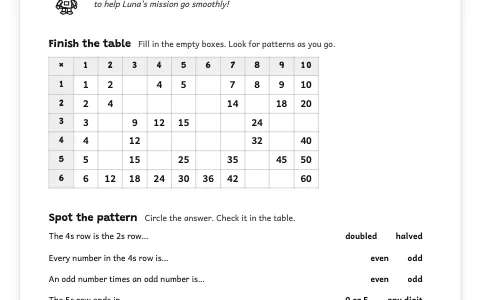
- 3.OA.10Find and explain number patterns.Patterns in tables
Fractions
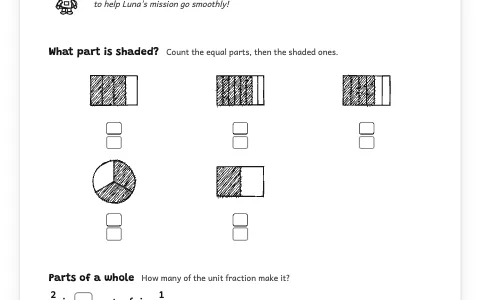
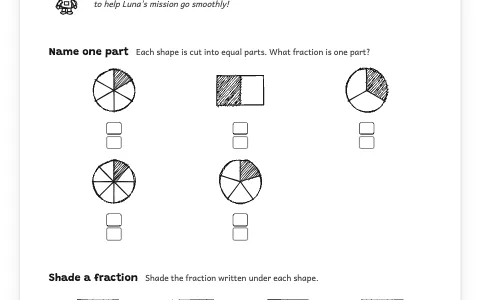
- 3.F.1The bottom number tells how many equal parts make the whole.Fractions of a whole
- 3.F.2The top number tells how many equal parts are chosen.Fractions of a whole
- 3.F.3See fractions as parts of a whole, points on a number line, and unit-fraction multiples.Fractions of a whole · Fractions on a number line
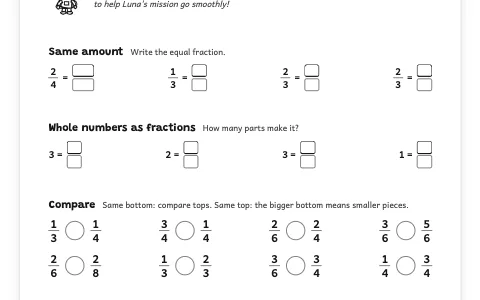
- 3.F.4Use number lines and area models to explain equivalent fractions (halves to eighths).Equivalent and comparing fractions
- 3.F.5Find equivalent fractions and explain why they are equal.Equivalent and comparing fractions
- 3.F.6Write whole numbers as fractions and spot fractions equal to whole numbers.Equivalent and comparing fractions
- 3.F.7Compare fractions with the same top or bottom number using <, >, =.Equivalent and comparing fractions
Measurement
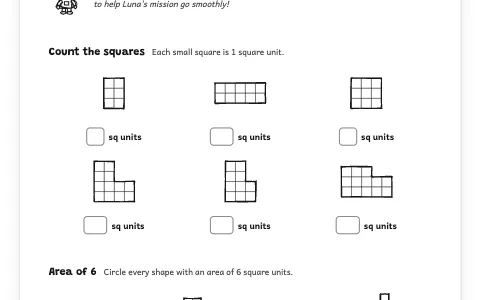
- 3.M.1Area is the amount of space inside a flat shape.What is area?
- 3.M.2A square unit is a 1-by-1 square used to measure area.What is area?
- 3.M.3A shape covered by n unit squares with no gaps has area n square units.What is area?
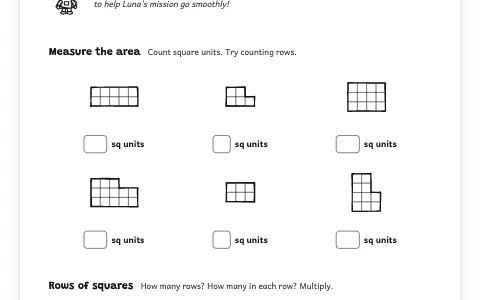
- 3.M.4Measure area by counting square units.Measuring area
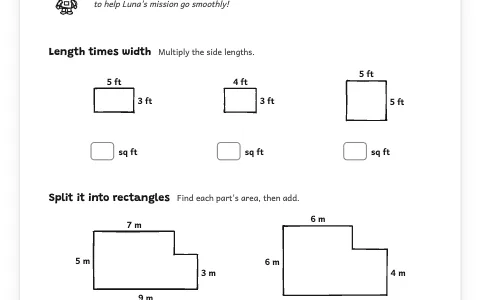
- 3.M.5Use tiles to show that multiplying side lengths gives a rectangle's area.Area by multiplying
- 3.M.6Solve word problems about the area of rectangles.Area by multiplying
- 3.M.7Use tiled area models to show the distributive property.Area by multiplying
- 3.M.8Find area by adding areas of rectangles that do not overlap.Area by multiplying
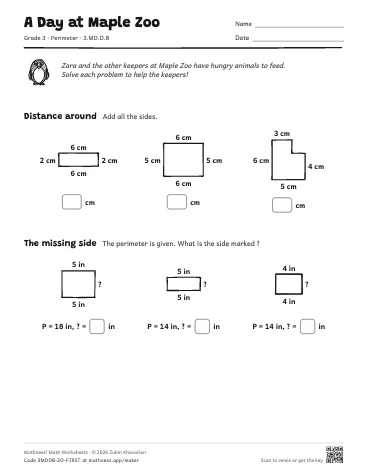
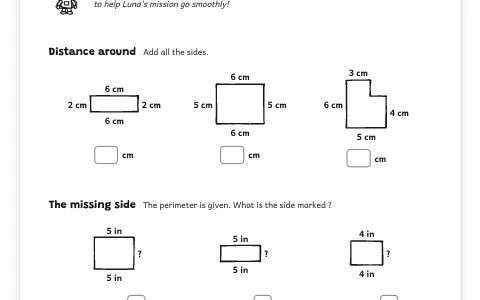
- 3.M.9Perimeter is the distance around a flat shape.Perimeter
- 3.M.10Solve perimeter problems, including missing sides and same perimeter with different areas.Perimeter
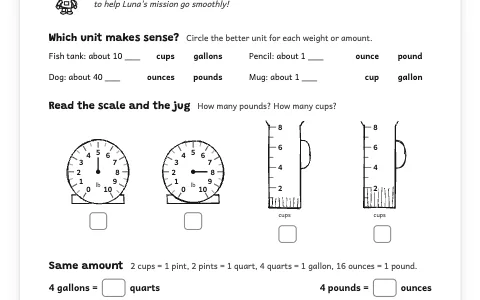
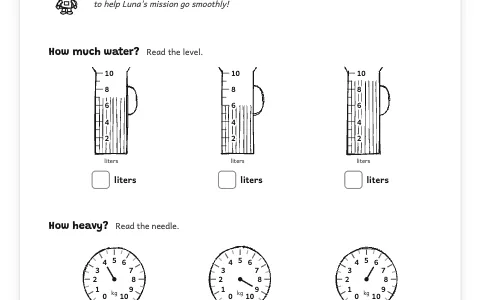
- 3.M.11Measure and estimate liquid volume in customary and metric units.Pounds, ounces, cups and gallons · Liters and kilograms
- 3.M.12Measure and estimate mass or weight in customary and metric units.Pounds, ounces, cups and gallons · Liters and kilograms
- 3.M.13Solve one-step word problems with masses or volumes in the same units.Liters and kilograms
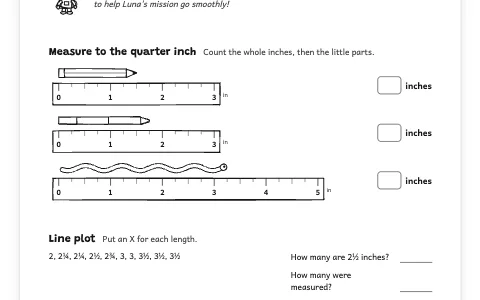
- 3.M.14Measure lengths to the nearest half or quarter inch with a ruler.Measuring to ¼ inch
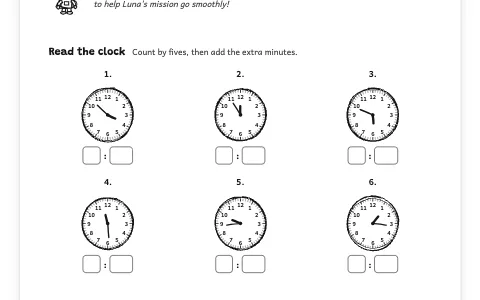
- 3.M.15Tell and write time to the nearest minute on analog and digital clocks.Time to the minute
- 3.M.16Solve time word problems by adding, subtracting, multiplying, or dividing minutes.Time to the minute
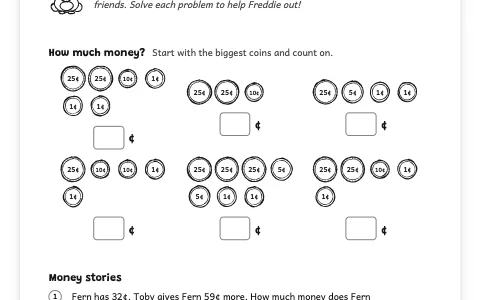
- 3.M.17Find the value of coins and bills up to $100 written with a decimal point.Counting money (Grade 2) · Decimals to hundredths (Grade 4)
- 3.M.18Make scaled tables, bar graphs, circle graphs, and line graphs from data.Circle graphs · Line graphs (Grade 4) · Scaled graphs
- 3.M.19Solve one- and two-step questions using scaled tables, bar, circle, and line graphs.Frequency tables · Circle graphs · Line graphs (Grade 4) · Scaled graphs
- 3.M.20Make a line plot marked in whole numbers, halves, or quarters.Measuring to ¼ inch


Geometry
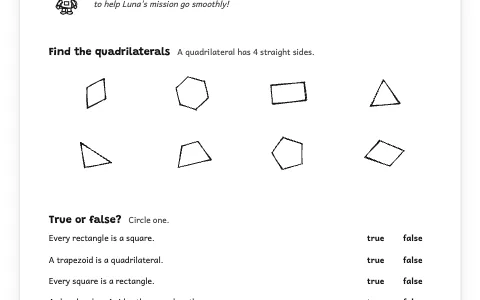
- 3.G.1Shapes in different groups can share features that define a larger group.Quadrilaterals
- 3.G.2A quadrilateral has four sides; relate trapezoids, parallelograms, rectangles, and squares.Quadrilaterals
- 3.G.3Split shapes into equal-area parts and name each part as a unit fraction.Equal parts as fractions
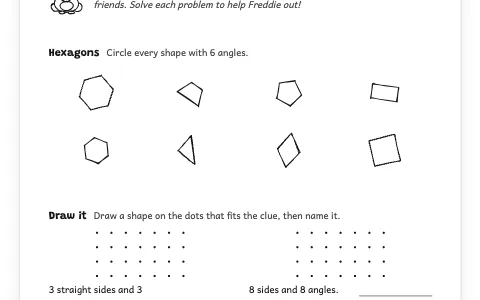
- 3.G.4Tell whether a shape is a polygon or not.Angles and faces (Grade 2)
- 3.G.5Classify polygons by their number of sides.Angles and faces (Grade 2)
Mathematical fluency
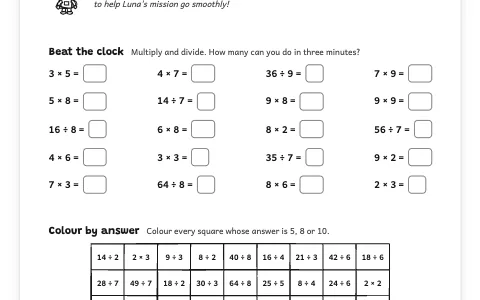
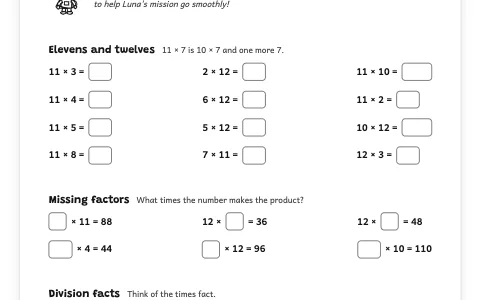
- 3.MF.1Use strategies to multiply facts through 12 mentally and fluently.Times tables to 12 · Multiplying with properties · Times tables
- 3.MF.2Know from memory multiplication facts for 0, 1, 2, 5, and 10 up to 12.Times tables to 12 · Multiplying with properties · Times tables
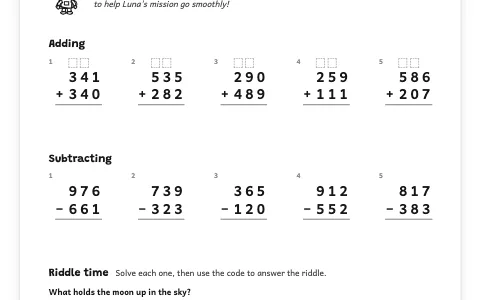
- 3.MF.3Add within 1000 fluently with different strategies.Adding and subtracting within 1000
- 3.MF.4Subtract within 1000 fluently with different strategies.Adding and subtracting within 1000
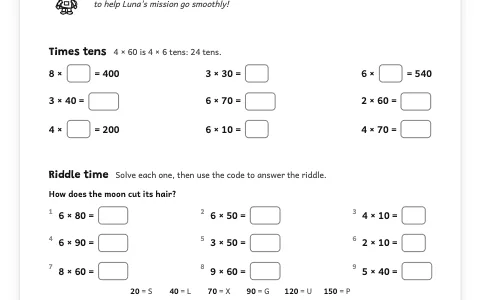
- 3.MF.5Multiply one-digit numbers by multiples of 10 such as 4 x 70.Multiplying by tens
Summaries are ours, in plain words. The same sheets by Common Core: Grade 3.