Oklahoma grade 1 math worksheets
Every Oklahoma grade 1 math standard by its own code, with the printable sheets that practise it: 32 of 32 have sheets. New problems every time, answer keys and a one-page guide for grown-ups. Free, no sign-up.
Numbers & operations
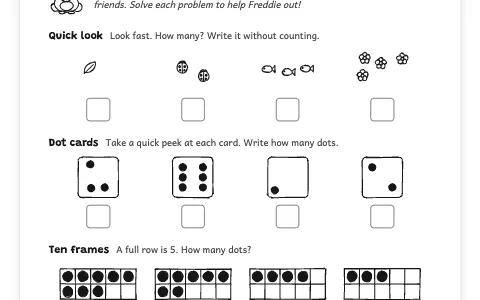
- 1.N.1.1Recognize quantities up to 20 in structured arrangements without counting.How many at a glance (Kindergarten)
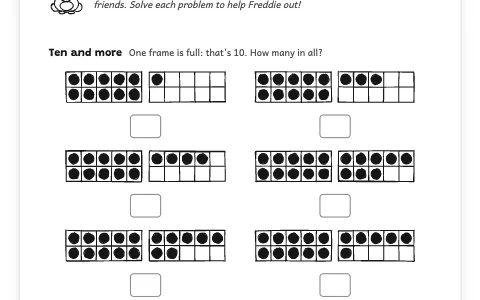
- 1.N.1.2Describe numbers 10 to 100 as tens and ones; 10 ones make a ten, 10 tens make 100.Ten and some more (Kindergarten) · Tens and ones
- 1.N.1.3Read, write and show whole numbers up to 100 in many ways.Counting to 120
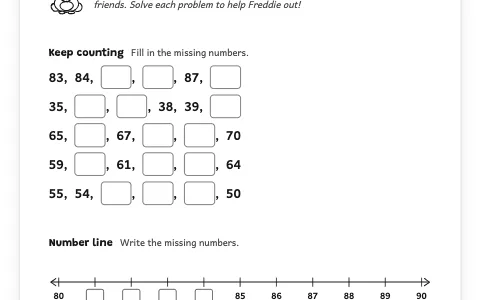
- 1.N.1.4Count forward with objects from any number to 100 by 1s, 2s, 5s and 10s.Counting to 120 · Skip counting (Grade 2)
- 1.N.1.5Count forward without objects by 1s, 2s, 5s and 10s up to 100.Counting to 120 · Skip counting (Grade 2)
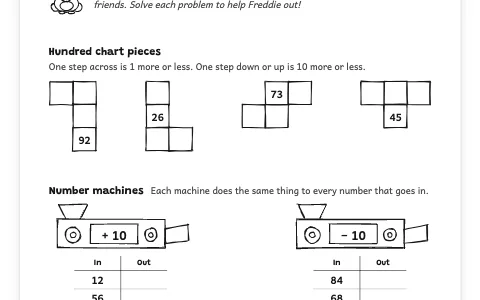
- 1.N.1.6Find 10 more or 10 less than a number up to 100.10 more and 10 less
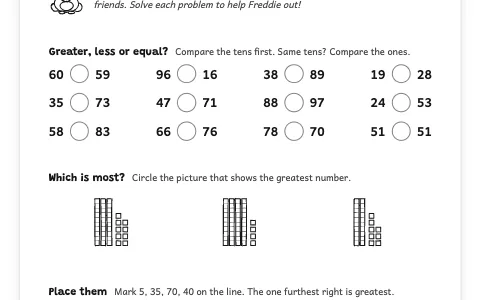
- 1.N.1.7Compare and order whole numbers from 0 to 100.Comparing two-digit numbers
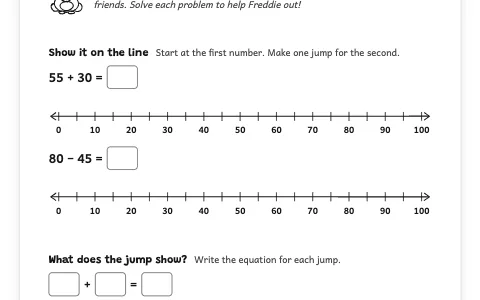
- 1.N.1.8Place a whole number up to 20 on an open number line.Sums on a number line (Grade 2)
- 1.N.1.9Describe how numbers compare using more than, less than and equal to.Comparing two-digit numbers
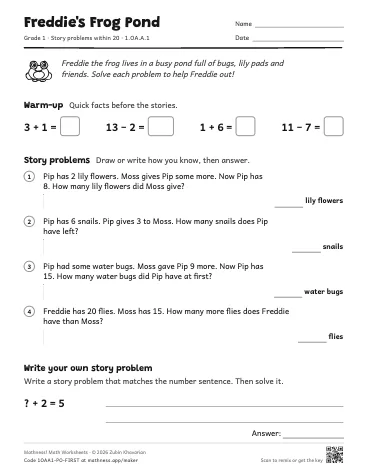
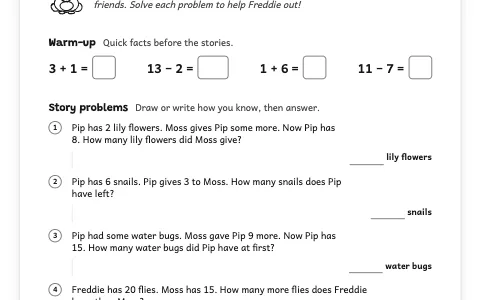
- 1.N.2.1Show and solve addition and subtraction problems within 10.Story problems within 20
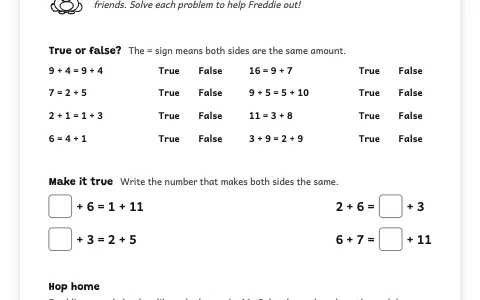
- 1.N.2.2Decide whether addition and subtraction equations are true.True or false equations
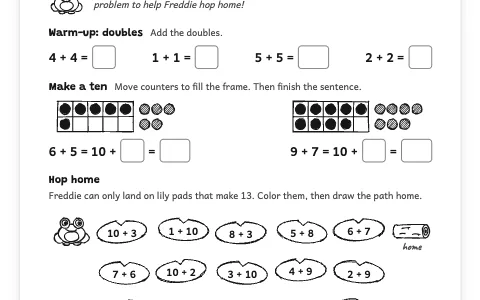
- 1.N.2.3Know addition and subtraction facts within 10 fluently.Adding within 20 · Subtracting within 20
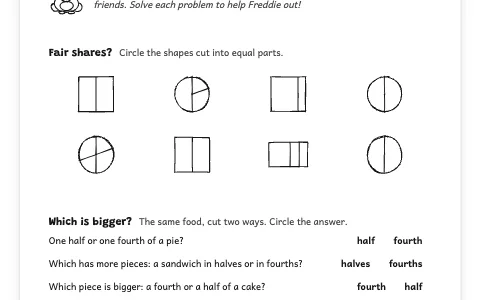
- 1.N.3.1Split a regular polygon with models and tell when the parts are equal.Halves and fourths
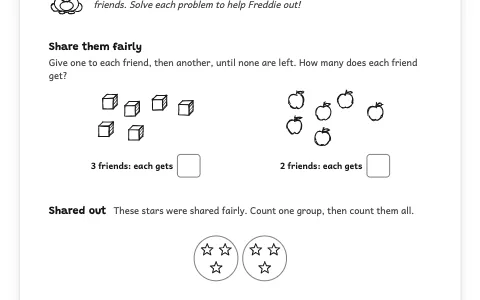
- 1.N.3.2Share a set of objects equally into two or three groups.Sharing fairly (Kindergarten)
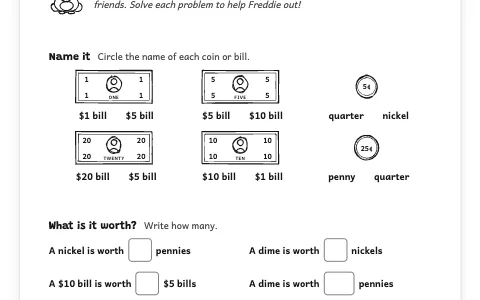
- 1.N.4.1Name pennies, nickels, dimes and quarters and state their values.Coins and bills
- 1.N.4.2Write a coin's value using the cent sign.Coins and bills
- 1.N.4.3Count a set of pennies, nickels or dimes up to $1 by 1s, 5s or 10s.Coins and bills
Algebraic reasoning
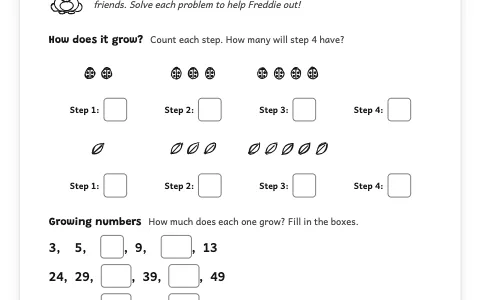
- 1.A.1.1Find, make, complete and extend repeating, growing and shrinking patterns.Growing patterns
Geometry & measurement
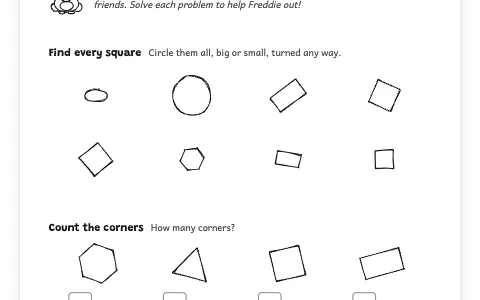
- 1.GM.1.1Point to regular and irregular trapezoids and hexagons when named.Naming shapes (Kindergarten)
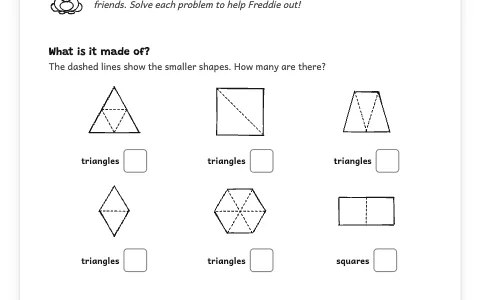
- 1.GM.1.2Put small flat shapes together to make a larger named shape.Putting shapes together
- 1.GM.1.3Build structures from solid shapes.Putting shapes together
- 1.GM.1.4Recognize cubes, cones, cylinders, pyramids and spheres.Naming shapes (Kindergarten)
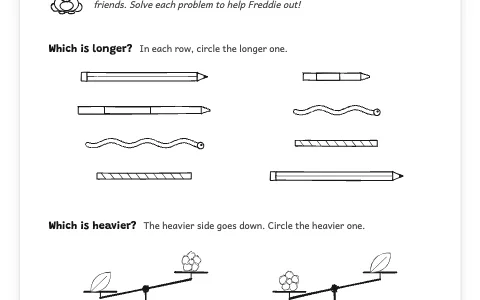
- 1.GM.2.1Measure length with nonstandard and standard tools.Measuring with units · Measuring with a ruler (Grade 2)
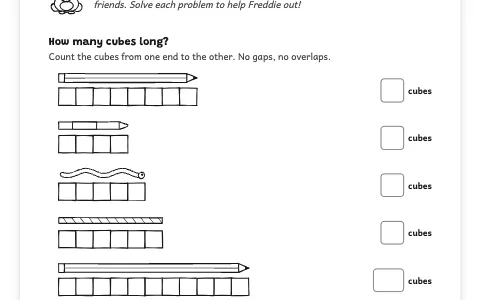
- 1.GM.2.2Show that length is the count of same-size units laid end to end with no gaps or overlaps.Measuring with units
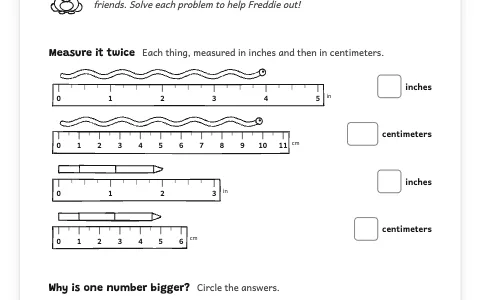
- 1.GM.2.3Measure one object with two different units and explain why the counts differ.Measuring in two units (Grade 2)
- 1.GM.2.4Report a length to the nearest whole unit.Measuring with units
- 1.GM.2.5Compare and sort containers by whether they hold more, less or the same.Longer, shorter, taller (Kindergarten)
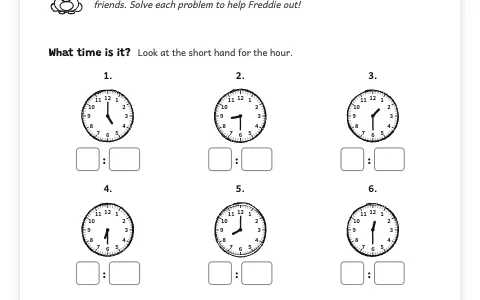
- 1.GM.3.1Tell time to the hour and half hour on analog and digital clocks.Time to the hour and half hour
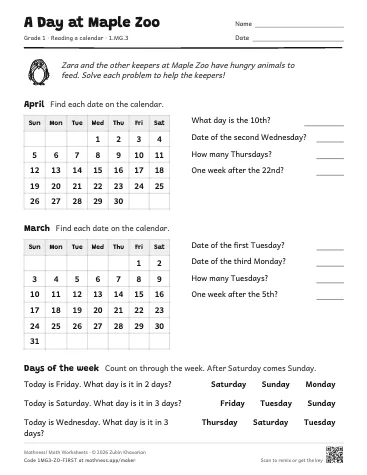
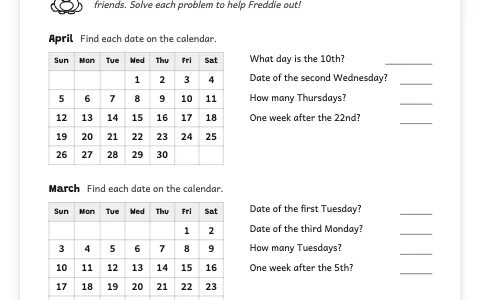
- 1.GM.3.2Describe calendar time in days, weeks, months and years.Reading a calendar
Data & probability
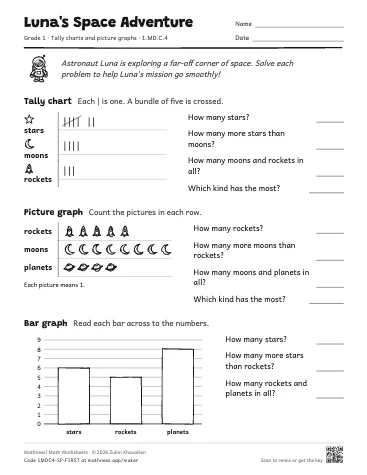
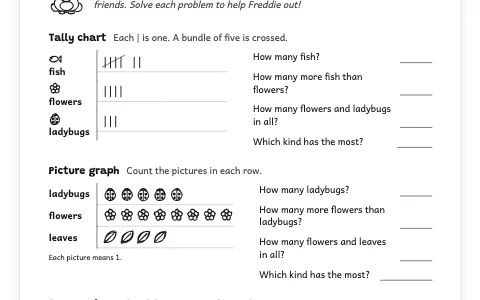
- 1.D.1.1Collect, sort and organize data in up to three categories with tallies, tables or Venn diagrams.Tally charts and picture graphs
- 1.D.1.2Make picture graphs and bar graphs where each symbol or unit stands for one.Tally charts and picture graphs
- 1.D.1.3Draw conclusions from picture graphs and bar graphs.Tally charts and picture graphs
Summaries are ours, in plain words. The same sheets by Common Core: Grade 1.