Minnesota (2027–28) grade 4 math worksheets
Every Minnesota 2027–28 grade 4 math standard by its own code, with the printable sheets that practise it: 40 of 40 have sheets. New problems every time, answer keys and a one-page guide for grown-ups. Free, no sign-up.
Data & probability
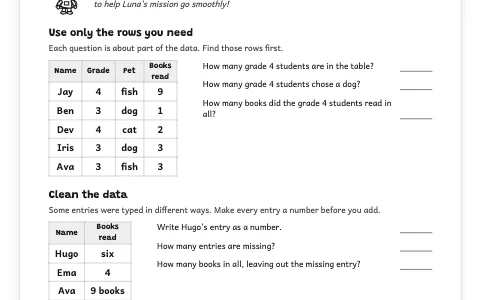
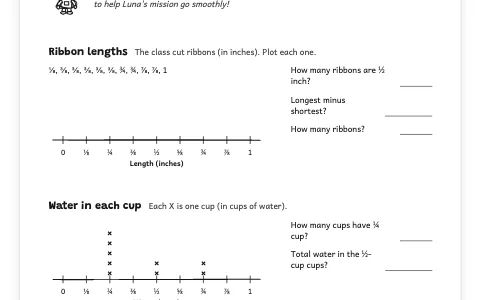
- 4.1.1.1Notice patterns in one or two related data sets and ask statistical questions.Choosing and cleaning data · Line plots with fractions
- 4.1.1.2Collect and organize data, look at variability and bias, and display it in several ways.Line plots with fractions
- 4.1.1.3Make predictions and see that how data were collected affects reliability.Choosing and cleaning data
- 4.1.1.4Analyze tables, double bar graphs, timelines, line plots or spreadsheets to support claims.Line plots with fractions
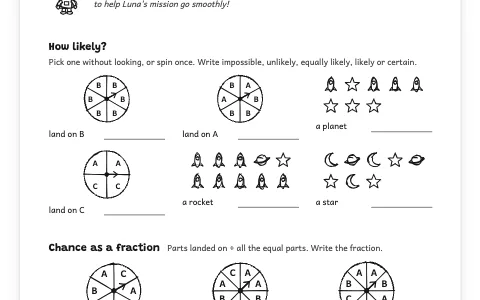
- 4.1.2.1Classify chance events with dice, coins, spinners or bags as impossible to certain.Chance and probability
- 4.1.2.2Place likelihoods on a 0-to-1 number line, with one half meaning equally likely.Chance and probability
Spatial reasoning
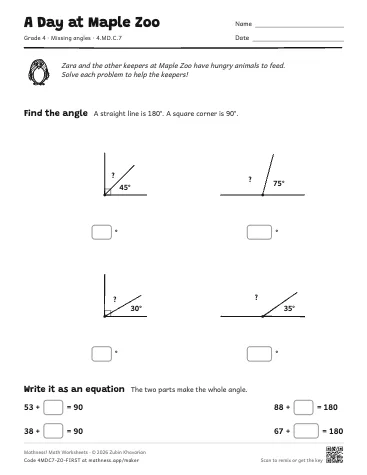
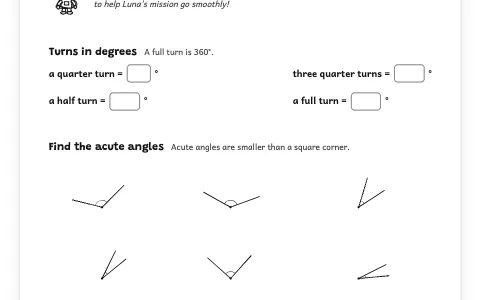
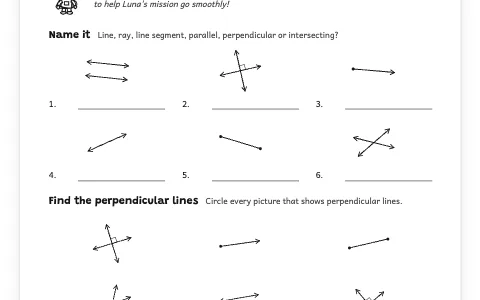
- 4.2.3.1Classify angles as acute, right or obtuse by estimating, comparing or measuring.Angles and degrees · Lines, rays and segments
- 4.2.3.2Measure to the nearest sixteenth inch or tenth of a centimeter.Line plots with fractions
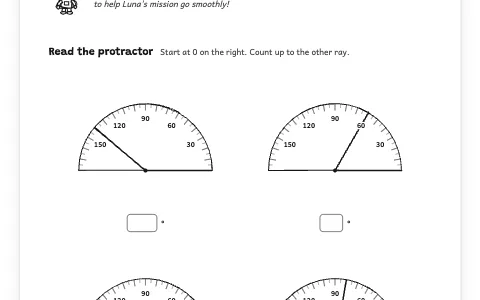
- 4.2.3.3Measure angles with a protractor.Measuring angles
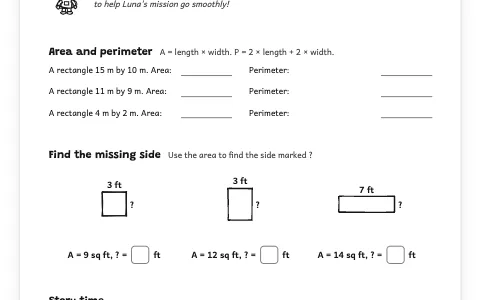
- 4.2.3.4Find perimeter and area of flat figures and label units.Area and perimeter formulas
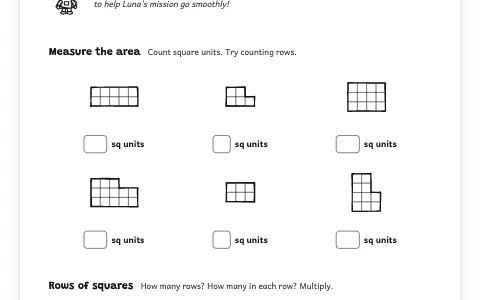
- 4.2.3.5Find areas of figures made of rectangles using dot or grid paper; use square units.Measuring area (Grade 3) · Area by multiplying (Grade 3)
- 4.2.3.6Explain and use the formula area equals length times width for rectangles.Area and perimeter formulas
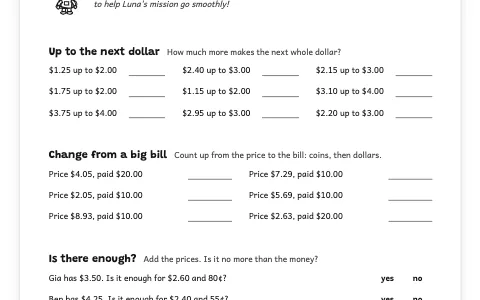
- 4.2.3.7Make change up to $20 using $ and ¢ correctly.Making change to $5 (Grade 3) · Measurement story problems
- 4.2.4.1Draw points, segments, rays, lines, angles and parallel or perpendicular lines and find them in figures.Lines, rays and segments
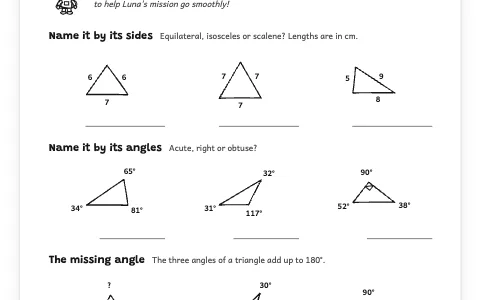
- 4.2.4.2Draw triangles classified by sides (scalene, isosceles, equilateral) and by angles.Sorting triangles (Grade 5) · Classifying shapes
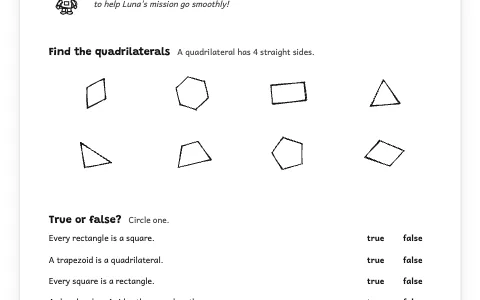
- 4.2.4.3Sort quadrilaterals in a hierarchy and see that subgroups share their category's traits.Quadrilaterals (Grade 3) · Shape families (Grade 5) · The quadrilateral family tree (Grade 5)
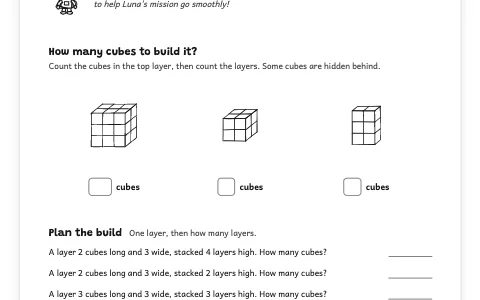
- 4.2.4.4Show and describe front, top and side views of solids built from cubes.Building with cubes (Grade 3)
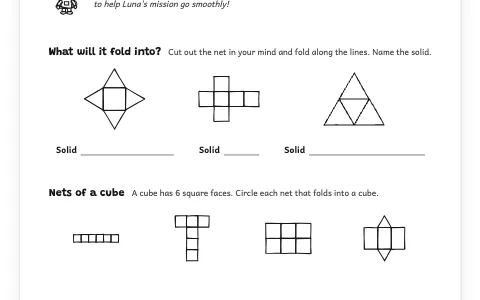
- 4.2.4.5Draw nets of cubes and tell which nets fold into a cube.Nets of solids (Grade 5)
Patterns & relationships
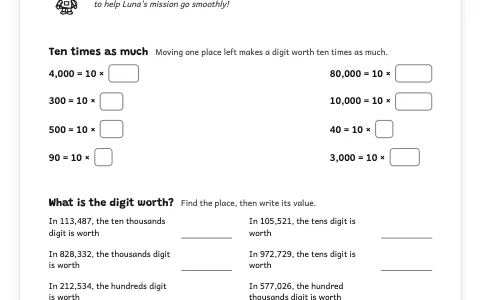
- 4.3.5.1Know each digit is worth ten times the same digit one place to its right.Ten times the place
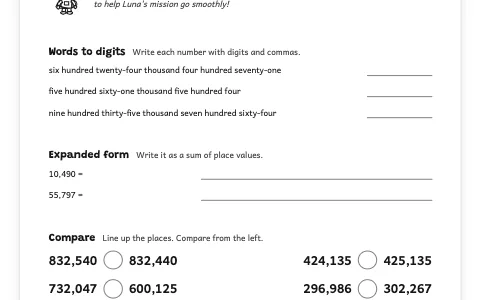
- 4.3.5.2Compare and order whole numbers up to 1,000,000 using <, = and >.Reading big numbers
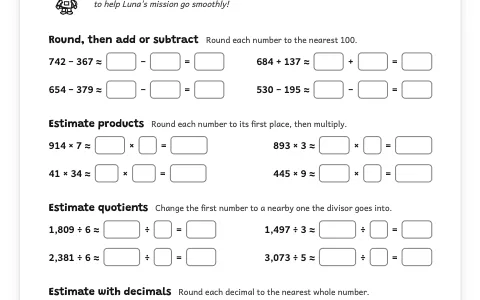
- 4.3.5.3Estimate sums and differences within 1,000,000 using place value and rounding.Estimating with all four operations (Grade 5) · Multi-step problems · Rounding big numbers
- 4.3.5.4Estimate products and quotients to judge whether results are reasonable.Estimating with all four operations (Grade 5) · Multi-step problems
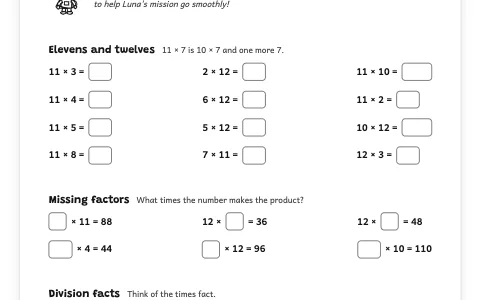
- 4.3.5.5Multiply numbers 0 to 12 fluently using properties of multiplication.Times tables to 12 (Grade 3) · Times tables (Grade 3)
- 4.3.5.6Explain with place value how to multiply by 10, 100 and 1000.Ten times the place · Powers of 10 (Grade 5)
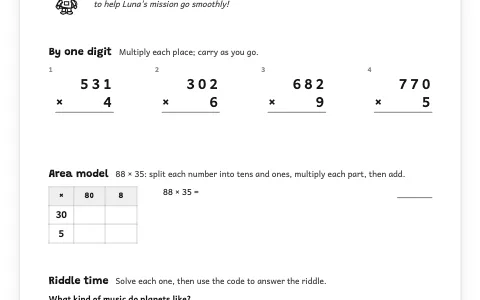
- 4.3.5.7Multiply two two-digit numbers, or up to four digits by one digit, with arrays and area models.Multiplying bigger numbers
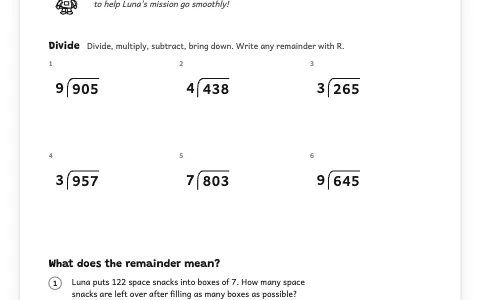
- 4.3.5.8Solve division problems with up to four-digit dividends and one-digit divisors.Long division
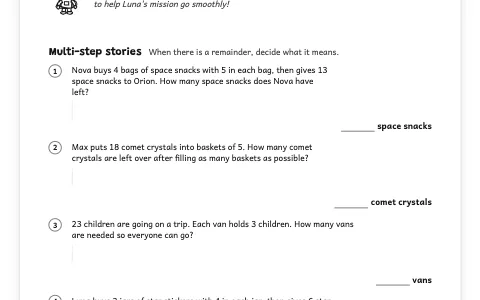
- 4.3.5.9Solve multi-step problems adding, subtracting and multiplying multi-digit whole numbers.Multi-step problems
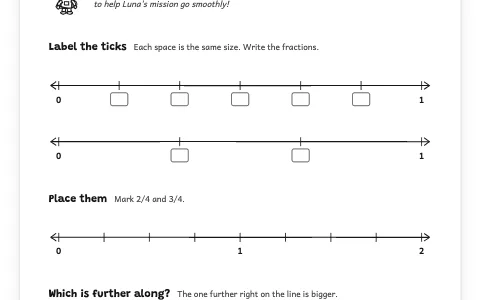
- 4.3.5.10Read, write and plot fractions and mixed numbers from 0 to 3 on a number line.Fractions on a number line (Grade 3) · Equivalent and comparing fractions (Grade 3) · Adding fractions
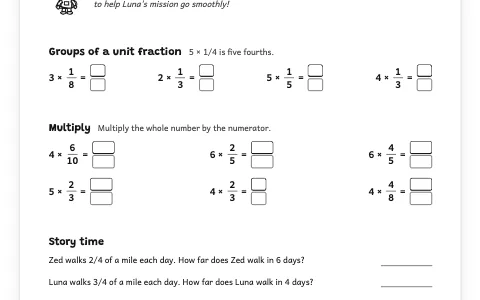
- 4.3.5.11Explain with models why a/b equals a times 1/b.Fraction times a whole number
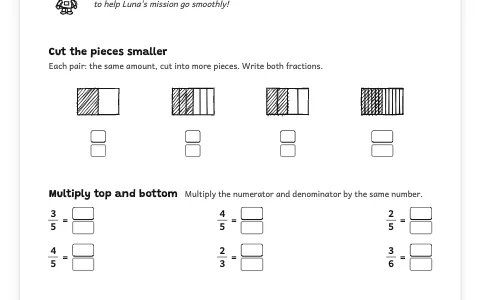
- 4.3.5.12Explain with models why multiplying top and bottom by n gives an equivalent fraction.Equivalent fractions
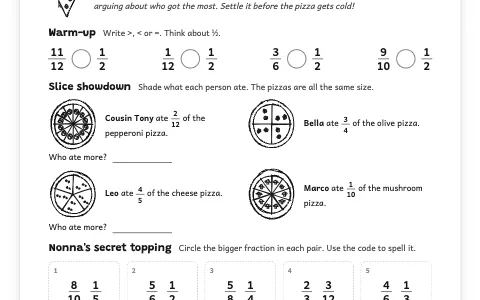
- 4.3.5.13Compare and order fractions from 0 to 3 using benchmarks, common numerators or denominators.Comparing fractions
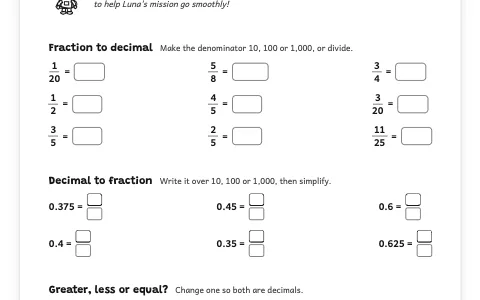
- 4.3.5.14Connect decimals and fractions; know decimal forms of one half, one quarter and three quarters.Fractions and decimals together (Grade 5) · Decimals to hundredths
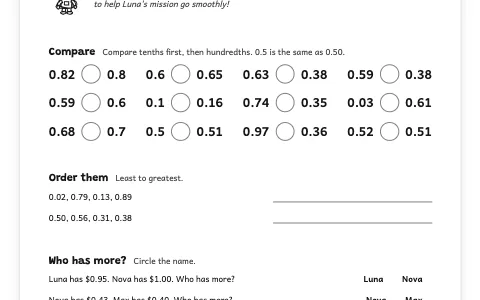
- 4.3.5.15Compare and order decimals to hundredths and name equivalent decimals.Comparing decimals
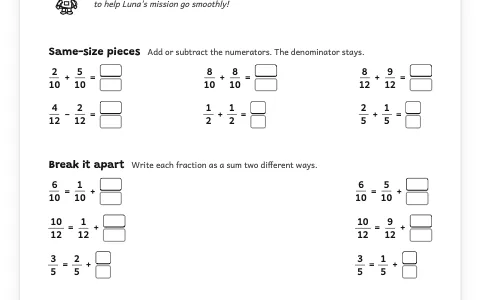
- 4.3.5.16Add and subtract halves, fourths and eighths with models, up to 2.Adding fractions
- 4.3.5.17Use the four operations for money choices about earning, spending, saving, credit and giving.Work, pay and prices (Grade 3) · Spending, credit and saving (Grade 3)
- 4.3.6.1Use relational thinking to find missing values in multiplication and division sentences.True or false equations · Missing factors (Grade 3)
- 4.3.6.2Make and justify claims using the distributive property for multi-digit multiplication.Multiplying bigger numbers
- 4.3.7.1Write a rule linking figure number to item count in a picture pattern and find figure n.Input-output tables · Number patterns
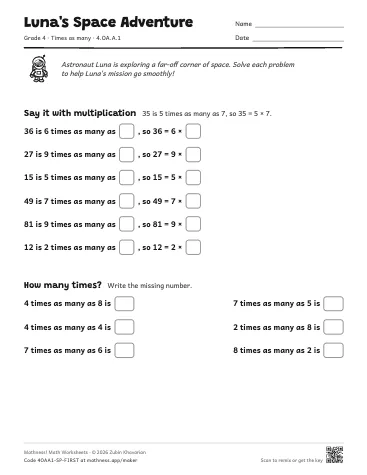
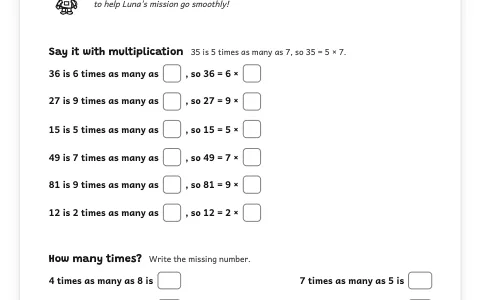
- 4.3.7.2Describe multiplicative patterns in words and compare additive and multiplicative rules.Times as many · Comparing with times · Number patterns
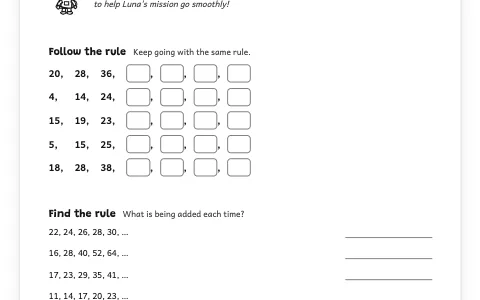
- 4.3.7.3Make a number or shape pattern from a rule and explain features not stated in the rule.Number patterns


Summaries are ours, in plain words. The same sheets by Common Core: Grade 4.