South Dakota (2027–28) grade 4 math worksheets
Every South Dakota 2027–28 grade 4 math standard by its own code, with the printable sheets that practise it: 51 of 51 have sheets. New problems every time, answer keys and a one-page guide for grown-ups. Free, no sign-up.
Numbers & operations
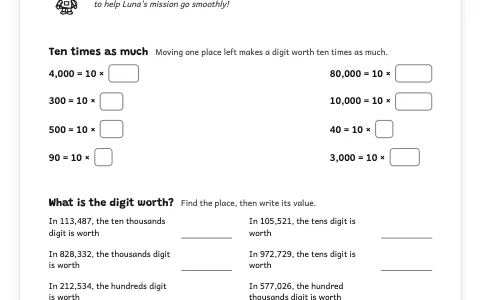
- 4.N.1A digit is worth ten times what it would be in the place to its right.Ten times the place
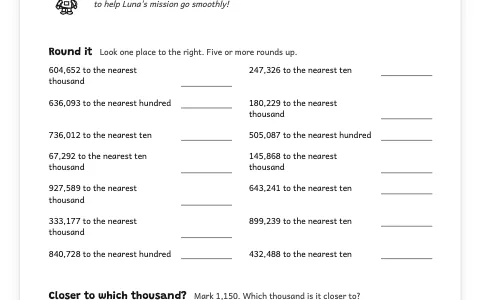
- 4.N.2Round multi-digit whole numbers to any place.Rounding big numbers
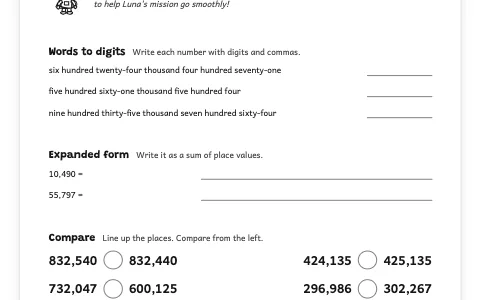
- 4.N.3Break five-digit numbers into place-value parts and rebuild them.Reading big numbers
- 4.N.4Read and write whole numbers to 1,000,000 in standard, word, and expanded form.Reading big numbers
- 4.N.5Compare multi-digit numbers by place value using <, >, =.Reading big numbers
Operations & algebraic thinking
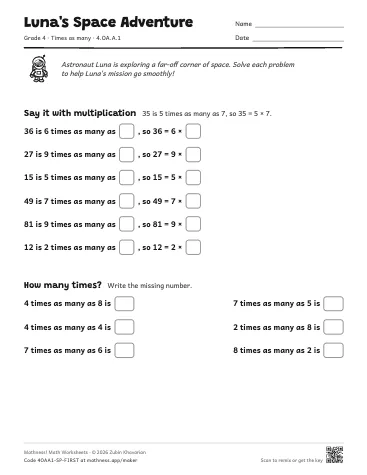
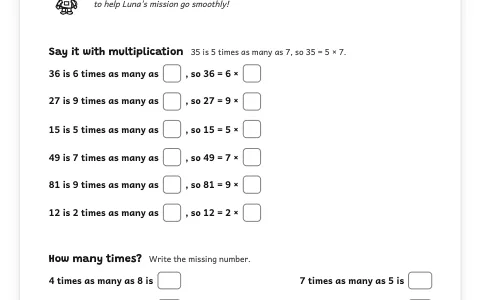
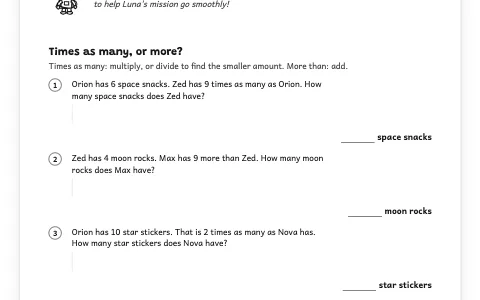
- 4.OA.1Show and explain multiplicative comparisons with equations, drawings, and words.Times as many
- 4.OA.2Solve multiplicative comparison problems and tell them apart from additive ones.Comparing with times
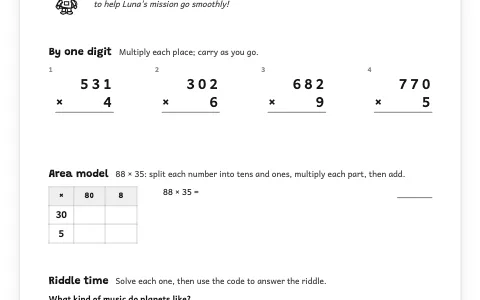
- 4.OA.3Multiply four-digit by one-digit numbers and two two-digit numbers.Multiplying bigger numbers
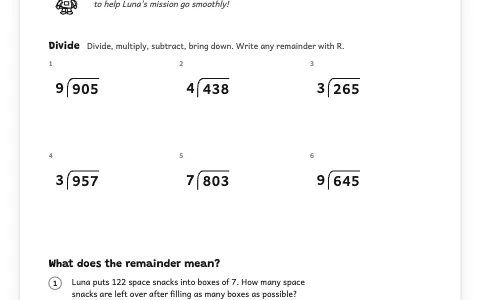
- 4.OA.4Divide four-digit numbers by one-digit numbers, with or without remainders.Long division
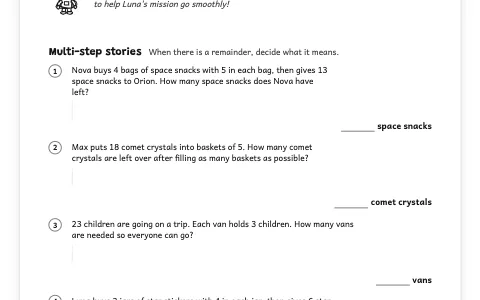
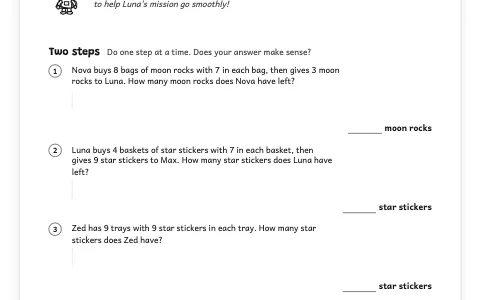
- 4.OA.5Decide what a remainder means in a one-step division problem.Multi-step problems
- 4.OA.6Solve multistep word problems with whole numbers and check answers by estimating.Multi-step problems
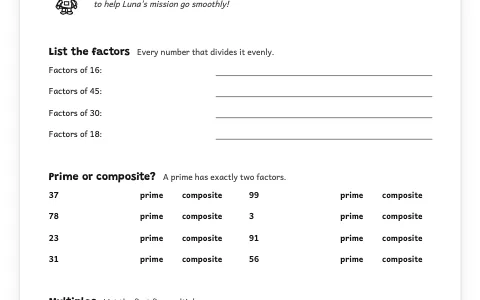
- 4.OA.7Find factor pairs for whole numbers up to 100.Factors and primes
- 4.OA.8A whole number up to 100 is a multiple of each of its factors.Factors and primes
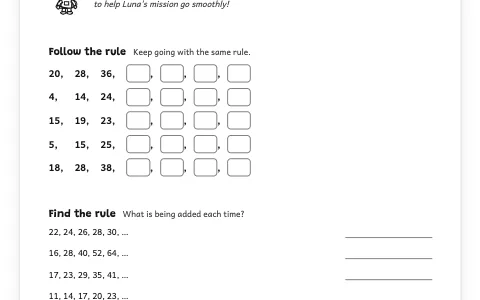
- 4.OA.9Find multiples of one-digit numbers.Factors and primes
- 4.OA.10Tell whether a number from 1 to 100 is prime or composite.Factors and primes
- 4.OA.11Make a number or shape pattern from a rule and notice its other features.Number patterns
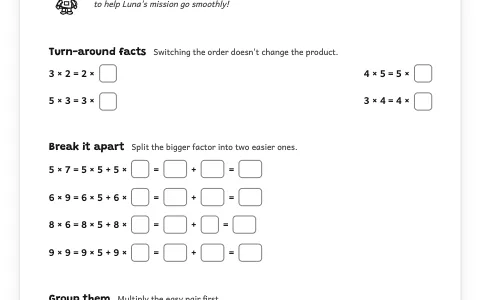
- 4.OA.12Use order, grouping, distributive, and identity properties when adding and multiplying.Multiplying with properties (Grade 3) · Multiplying bigger numbers
- 4.OA.13Evaluate expressions with all four operations using order of operations, no parentheses.Two-step story problems (Grade 3) · Parentheses and brackets (Grade 5)
Fractions
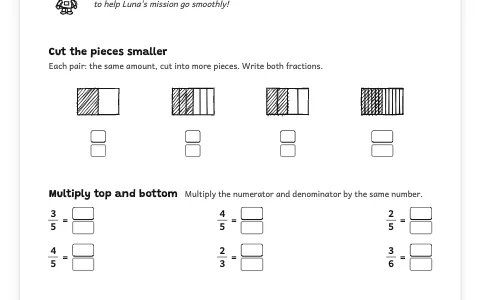
- 4.F.1Use models to explain why multiplying top and bottom by the same number keeps a fraction equal.Equivalent fractions
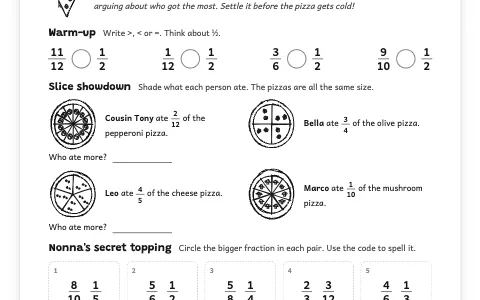
- 4.F.2Compare fractions with different tops and bottoms using common denominators or numerators.Comparing fractions
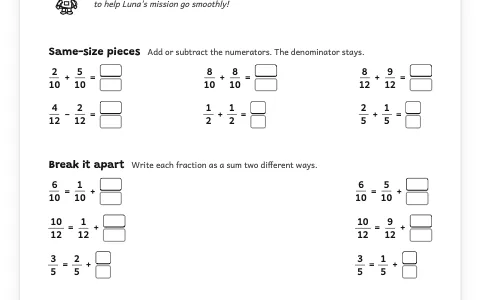
- 4.F.3Add and subtract fractions with like denominators.Adding fractions
- 4.F.4Solve word problems adding or subtracting like-denominator fractions of the same whole.Adding fractions
- 4.F.5Break a fraction into a sum of fractions with the same denominator.Adding fractions
- 4.F.6Add and subtract mixed numbers with like denominators.Adding fractions
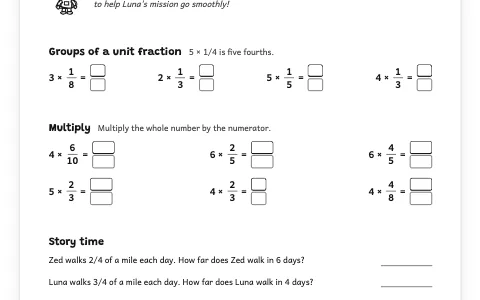
- 4.F.7Multiply a fraction by a whole number.Fraction times a whole number
- 4.F.8A fraction a/b is a copies of 1/b.Fraction times a whole number
- 4.F.9A multiple of a/b is also a multiple of 1/b.Fraction times a whole number
- 4.F.10Solve word problems multiplying a fraction by a whole number.Fraction times a whole number
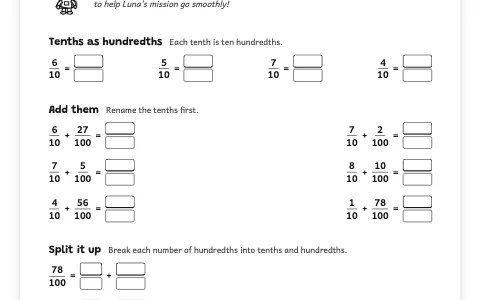
- 4.F.11Add tenths and hundredths by rewriting tenths as hundredths.Tenths and hundredths
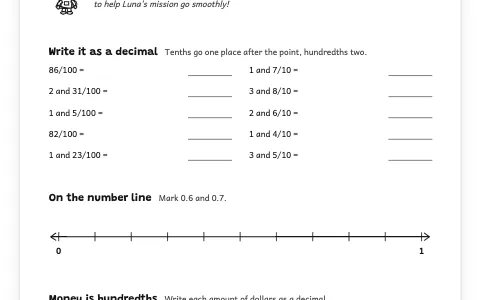
- 4.F.12A decimal has a whole part and a fraction part split by a decimal point.Decimals to hundredths
- 4.F.13Write tenths and hundredths as decimals and place them on a number line.Decimals to hundredths
- 4.F.14Read, write, and give the value of decimals to hundredths.Decimals to hundredths
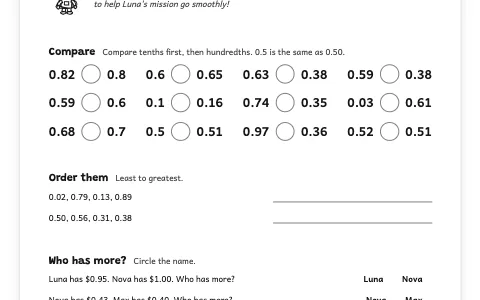
- 4.F.15Compare decimals to hundredths on a number line and with <, >, =.Comparing decimals
Measurement
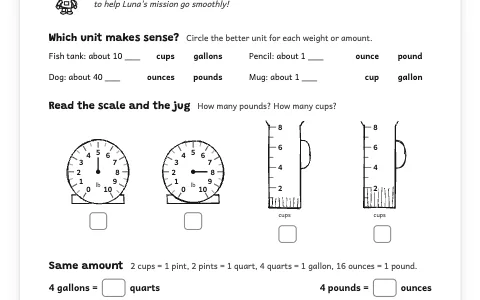
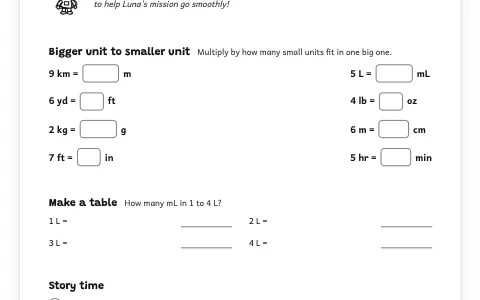
- 4.M.1Measure length, weight, mass, capacity, and time in customary and metric units.Pounds, ounces, cups and gallons (Grade 3) · Time to the minute (Grade 3) · Liters and kilograms (Grade 3) · Measuring to ¼ inch (Grade 3) · Converting units
- 4.M.2Convert larger units to smaller units within one measurement system.Converting units
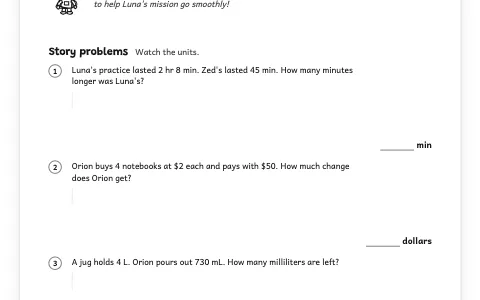
- 4.M.3Solve word problems about distance, time, capacity, mass, and money with fractions and decimals.Measurement story problems
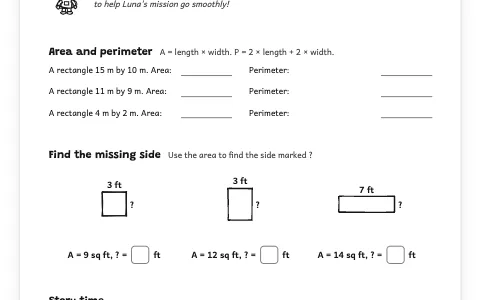
- 4.M.4Explain and use rectangle area and perimeter formulas in real problems.Area and perimeter formulas
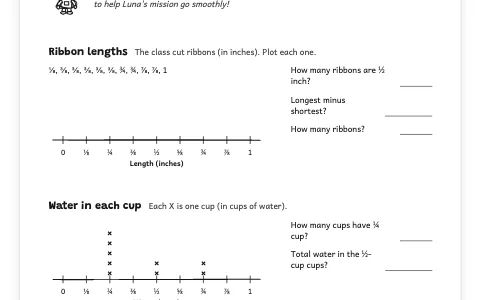
- 4.M.5Make a line plot of measurements in halves, fourths, eighths and solve problems with it.Line plots with fractions
Geometry
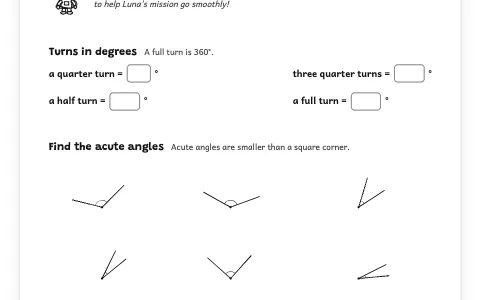
- 4.G.1An angle is formed by two rays with a shared endpoint.Angles and degrees
- 4.G.2Measure and draw angles in degrees with a protractor; a degree is 1/360 of a circle.Angles and degrees · Measuring angles
- 4.G.3Classify and draw right, acute, obtuse, and straight angles.Lines, rays and segments
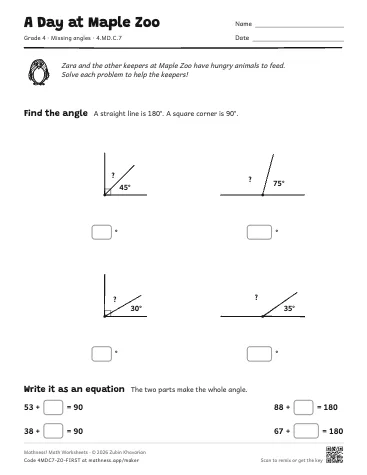
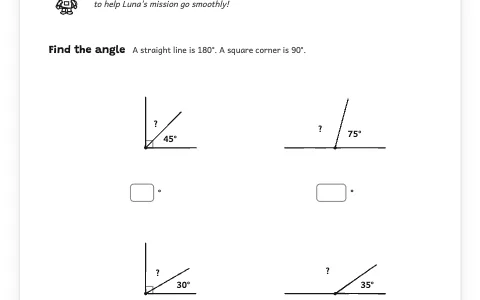
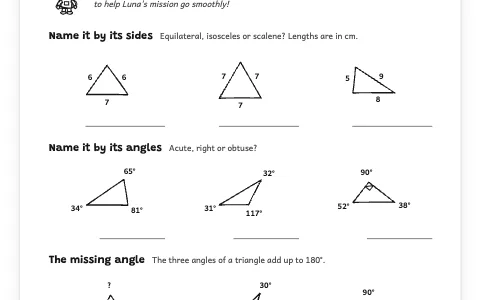
- 4.G.4Angle measures add: the parts of an angle sum to the whole.Missing angles
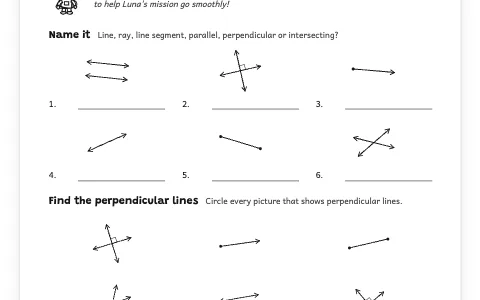
- 4.G.5Identify and draw points, lines, segments, rays, and angles.Lines, rays and segments
- 4.G.6Identify and draw intersecting, parallel, and perpendicular lines.Lines, rays and segments
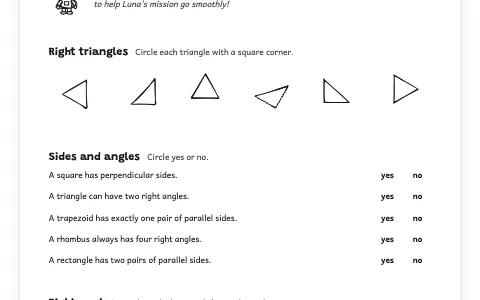
- 4.G.7A trapezoid is a four-sided shape with exactly one pair of parallel sides.Classifying shapes
- 4.G.8Describe squares, rectangles, trapezoids, rhombuses by parallel and perpendicular sides.Classifying shapes
- 4.G.9Identify and draw angle types and equilateral, scalene, right, acute, obtuse triangles.Sorting triangles (Grade 5) · Lines, rays and segments · Classifying shapes
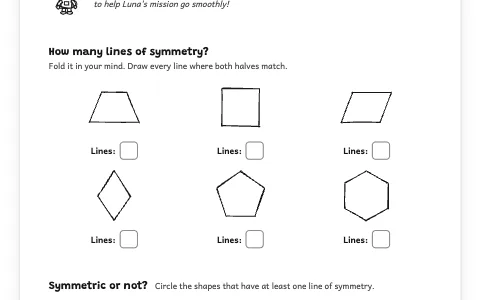
- 4.G.10Find and draw lines of symmetry.Lines of symmetry
Mathematical fluency
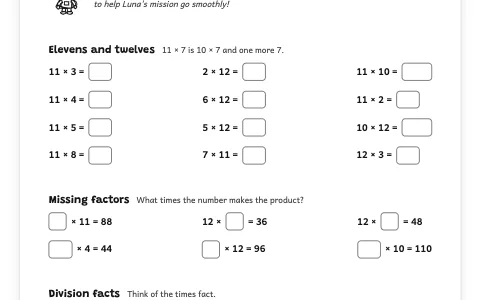
- 4.MF.1Know multiplication facts 0 to 12 from memory.Times tables to 12 (Grade 3)
- 4.MF.2Know division facts 0 to 12 from memory.Times tables to 12 (Grade 3)
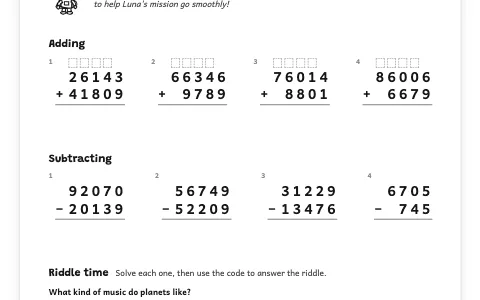
- 4.MF.3Add and subtract multi-digit whole numbers fluently with an algorithm.Adding and subtracting big numbers
Summaries are ours, in plain words. The same sheets by Common Core: Grade 4.