Minnesota grade 4 math worksheets
Every Minnesota grade 4 math standard by its own code, with the printable sheets that practise it: 27 of 27 have sheets. New problems every time, answer keys and a one-page guide for grown-ups. Free, no sign-up.
Number & operations
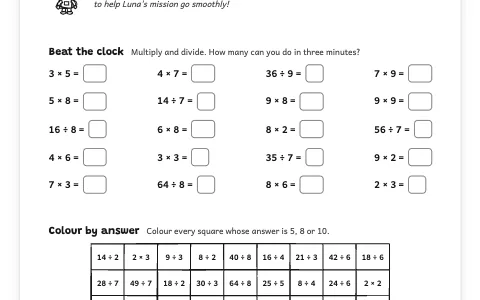
- 4.1.1.1Know multiplication and division facts fluently.Times tables (Grade 3)
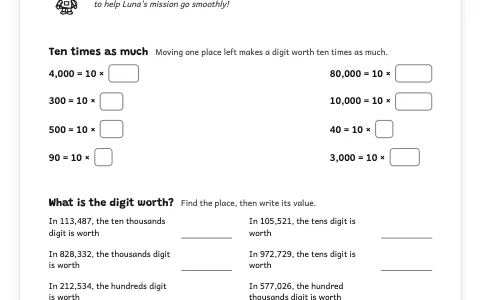
- 4.1.1.2Use place value to multiply numbers by 10, 100 and 1000.Ten times the place · Powers of 10 (Grade 5)
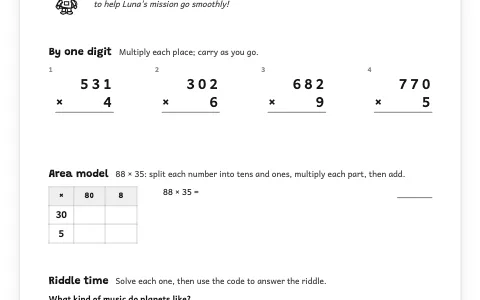
- 4.1.1.3Multiply multi-digit numbers with place-value methods including the standard algorithm.Multiplying bigger numbers · Multi-digit multiplication (Grade 5)
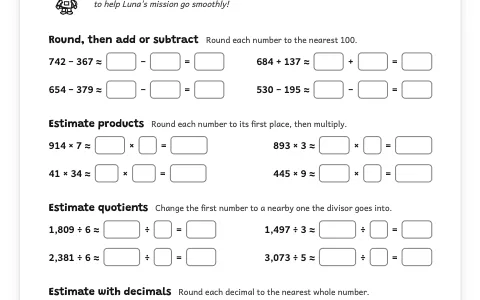
- 4.1.1.4Estimate products and quotients by rounding to check if answers are reasonable.Estimating with all four operations (Grade 5) · Multi-step problems
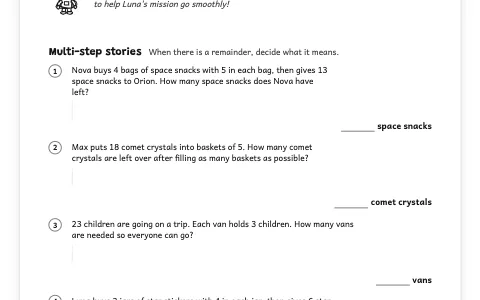
- 4.1.1.5Solve multi-step problems adding, subtracting and multiplying multi-digit whole numbers.Multi-step problems
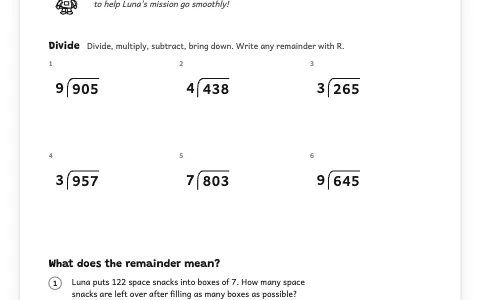
- 4.1.1.6Divide multi-digit whole numbers by one- or two-digit numbers using strategies like partial quotients.Long division · Dividing by two digits (Grade 5)
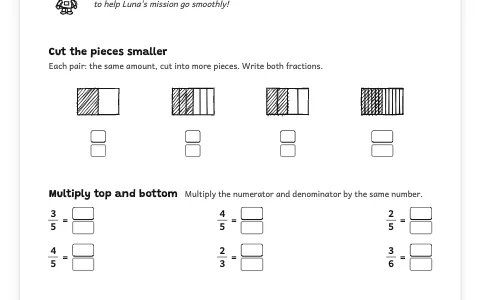
- 4.1.2.1Use fraction models to show and find equivalent fractions.Equivalent fractions
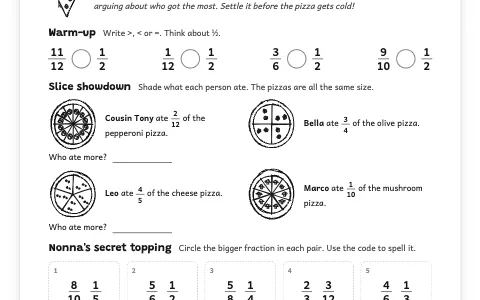
- 4.1.2.2Place fractions on a number line and compare fractions, mixed numbers and whole numbers.Comparing fractions
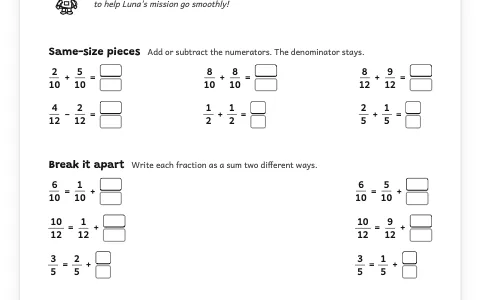
- 4.1.2.3Add and subtract fractions with like denominators using models; build a rule.Adding fractions
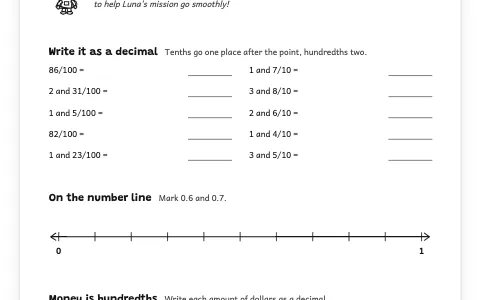
- 4.1.2.4Read and write decimals and describe their place values through thousandths.Decimals to hundredths · Decimals to thousandths (Grade 5)
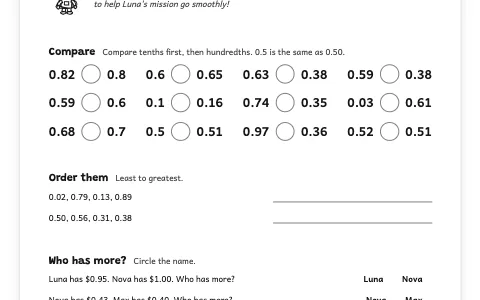
- 4.1.2.5Compare and order decimals and whole numbers using place value and models.Comparing decimals
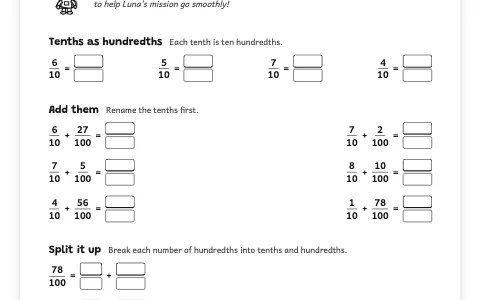
- 4.1.2.6Write tenths and hundredths as fractions and decimals; know decimal forms of halves and fourths.Tenths and hundredths · Decimals to hundredths
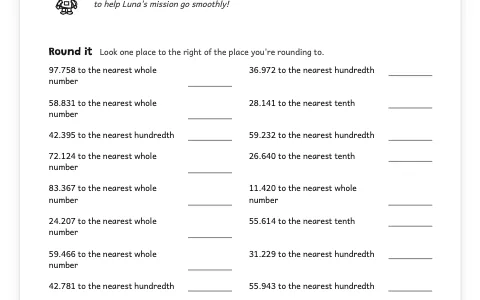
- 4.1.2.7Round decimals to the nearest tenth.Rounding decimals (Grade 5)
Algebraic reasoning
- 4.2.1.1Make input-output rules using all four operations and record them in tables.Input-output tables · Number patterns
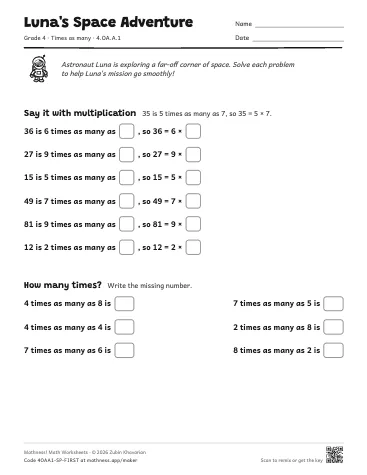
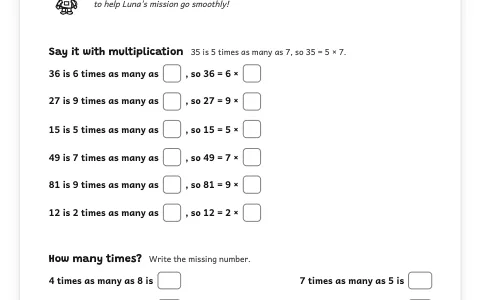
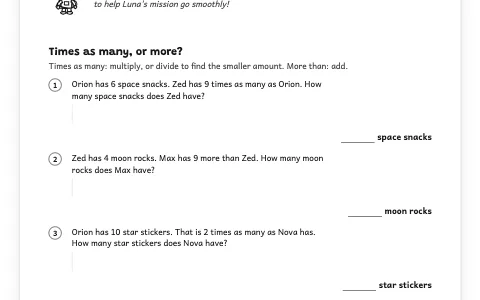
- 4.2.2.1Interpret multiplication and division number sentences with unknowns using real situations.Times as many · Comparing with times
- 4.2.2.2Write multiplication or division number sentences for problems and solve for unknowns.Comparing with times

Geometry & measurement
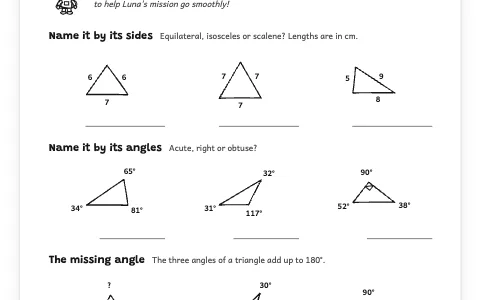
- 4.3.1.1Describe, classify and sketch triangles, including equilateral, right, acute and obtuse.Sorting triangles (Grade 5) · Lines, rays and segments · Classifying shapes
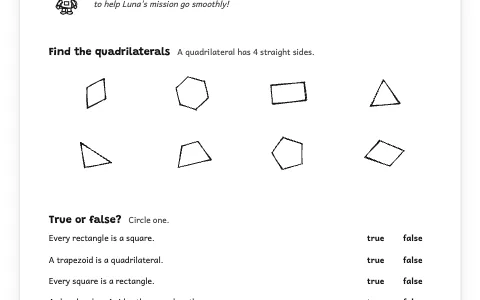
- 4.3.1.2Describe, classify and draw quadrilaterals such as rhombuses, trapezoids, parallelograms and kites.Quadrilaterals (Grade 3) · Classifying shapes
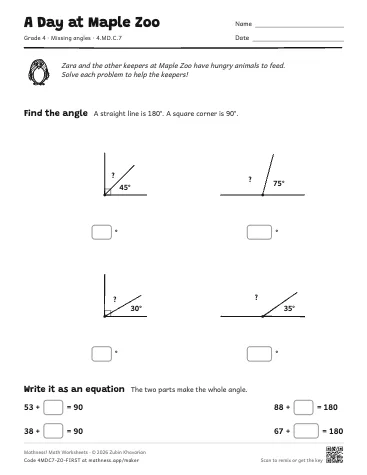
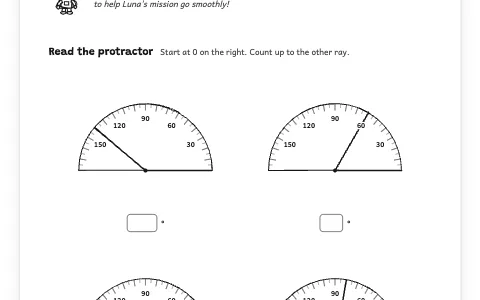
- 4.3.2.1Measure angles with a protractor or angle ruler.Measuring angles
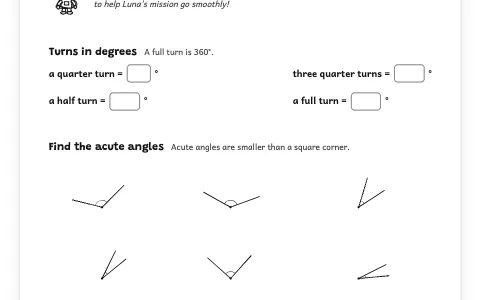
- 4.3.2.2Compare angle sizes and classify angles as acute, right or obtuse.Angles and degrees · Lines, rays and segments
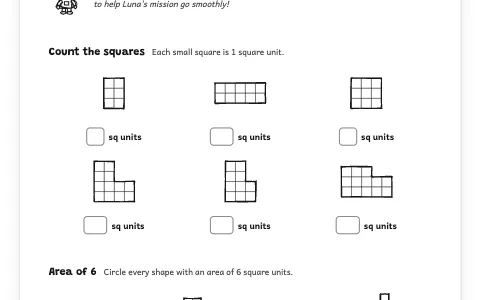
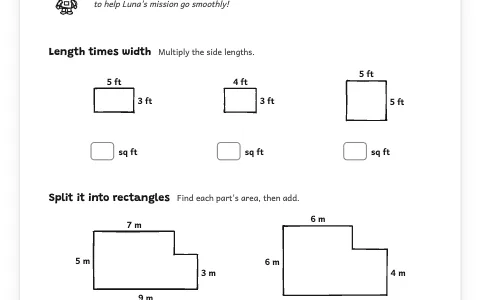
- 4.3.2.3Find area by counting unit squares and explain why length times width works.What is area? (Grade 3) · Measuring area (Grade 3) · Area by multiplying (Grade 3)
- 4.3.2.4Find areas of figures that split into rectangles, labeling in square units.Area by multiplying (Grade 3) · Area and perimeter formulas
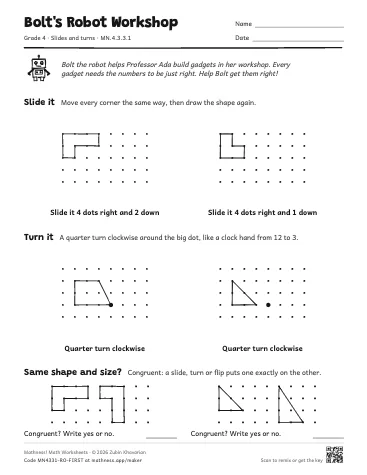
- 4.3.3.1Slide figures (translations).Slides and turns
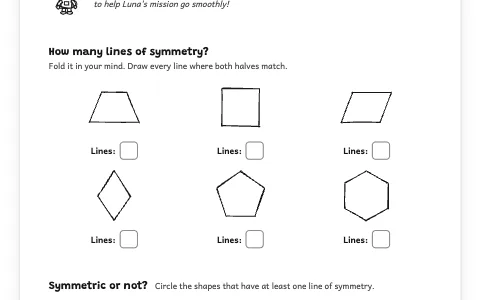
- 4.3.3.2Flip figures over vertical or horizontal lines and connect flips to lines of symmetry.Lines of symmetry
- 4.3.3.3Turn figures 90 degrees clockwise or counterclockwise (rotations).Slides and turns
- 4.3.3.4Show figures are congruent using slides, flips and turns.Slides and turns

Data analysis
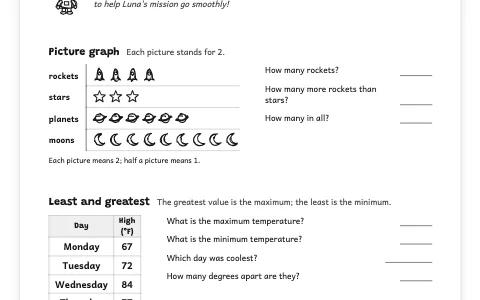
- 4.4.1.1Display data, including fractions or decimals, in tables, bar graphs, timelines and Venn diagrams.Scaled graphs (Grade 3) · Line plots with fractions
Summaries are ours, in plain words. The same sheets by Common Core: Grade 4.